
Cervical Cancer Surgery Chennai: Robotic vs Open
Cervical Cancer Surgery Chennai: Robotic vs Open Lakshmi’s biopsy report confirmed early-stage cervical cancer, and within days she found herself comparing two very different accounts online. One website described robotic surgery as faster recovery and smaller scars. Another mentioned something about a trial that changed how doctors think about robotic cervical cancer surgery altogether. Caught between the two, she didn’t know which to trust. If you are researching cervical cancer surgery in Chennai right now, you deserve a straight answer, not marketing language dressed up as medical advice. Understanding Radical Hysterectomy for Cervical Cancer Radical hysterectomy is the standard surgical treatment for early-stage cervical cancer. Unlike a simple hysterectomy, it removes the uterus along with surrounding tissue, the upper part of the vagina, and nearby lymph nodes, because cervical cancer can spread into these areas even when it looks confined on a scan. This surgery can be performed two ways. Open surgery uses a single abdominal incision, giving the surgeon direct access to the pelvis. Robotic or minimally invasive surgery uses several small incisions and a robotic surgical system, offering smaller scars and often a shorter hospital stay. Here is the part many websites leave out, and it matters. A large international trial published in 2018 found that minimally invasive radical hysterectomy, including robotic surgery, was associated with lower survival rates than open surgery specifically for early-stage cervical cancer. That finding changed global treatment guidelines almost overnight. It does not mean robotic surgery is unsafe in general. It means that for this particular cancer and this particular operation, the evidence currently favours the open approach. This is not the case for every gynecologic cancer. Robotic surgery remains the preferred, well-supported approach for many endometrial and early ovarian cancer cases, where the evidence points in the opposite direction. The confusion online largely comes from applying findings about one cancer type to a completely different one, which is exactly the kind of generalisation a proper cervical cancer surgery Chennai consultation should correct rather than repeat. Recovery differences between the two approaches are real but should be weighed against safety, not instead of it. Open surgery typically involves a longer hospital stay, usually four to six days, and a longer return to full activity, often six weeks or more. Robotic surgery can shorten both considerably. For cervical cancer, though, the honest starting point of the conversation has to be survival outcomes first, with recovery discussed as a secondary factor once the safer approach for your specific stage has been identified. Why This Matters for Women in Chennai and Tamil Nadu This distinction matters enormously in a market where robotic surgery is often marketed as automatically superior. Women in Chennai searching for the best hospital for cervical cancer surgery in Chennai deserve a surgeon who will tell them when minimally invasive surgery is not the safer option, not one who defaults to robotics because it sounds more advanced. Cervical cancer also tends to affect women at a somewhat younger age than other gynecologic cancers, often while they are still raising young children or building a career. Getting the surgical approach right the first time, rather than needing to revisit treatment later, carries weight that goes beyond the operation itself. Access to a gynecologic oncologist who understands this specific evidence, rather than a general surgeon extrapolating from other cancer types, is not always guaranteed outside major cancer centres. Having that expertise available locally in Chennai means women do not have to choose between getting the right surgical advice and getting it close to home. For families travelling in from smaller towns across Tamil Nadu, this local availability changes the entire experience of a cervical cancer diagnosis. Instead of a rushed referral to a distant metro city and an unfamiliar system, a proper cervical cancer surgery Chennai consultation can happen within days, with the same specialist available for every follow-up visit afterward. Dr. Aiswarya Sekar’s Approach and Expertise Dr. Aiswarya Sekar is a Consultant Gynecologic Oncologist and Robotic Surgeon at Dr. Rela Institute and Medical Centre in Chromepet, Chennai, trained in Gynecologic Oncology at Tata Memorial Hospital, Mumbai. Her practice includes both robotic and open surgical techniques, which means the decision for any individual patient is based on the specific cancer, not on which equipment happens to be available that day. For cervical cancer specifically, she follows current evidence-based guidelines that favour open radical hysterectomy for most early-stage cases, discussing this openly with patients rather than assuming they want the less invasive option by default. Robotic surgery vs open surgery for cervical cancer, which is safer, is a question she addresses directly during consultation, using the patient’s own scans and staging rather than general statements. Where fertility preservation is medically appropriate for very early, carefully selected cases, her training allows that conversation to happen as well, always framed by what the evidence actually supports rather than what a patient might hope to hear. What to Expect: Your Care Journey at Rela Hospital Your first visit typically involves a detailed review of your biopsy results, imaging, and cancer staging, since the recommended surgical approach depends heavily on how early the cancer was caught and how far it may have spread. From there, Dr. Aiswarya explains the recommended approach in plain terms, including why open or robotic surgery is being suggested for your specific case. If cervical cancer surgery cost and recovery in Chennai is a practical concern for your family, this is also the point where realistic timelines and expectations are discussed, so you can plan around work, childcare, or travel from outside the city if needed. Surgery is scheduled once staging is confirmed, and recovery is monitored closely afterward, with follow-up visits structured around your pathology results and any additional treatment, such as radiation, that your case might require. Throughout this process, questions are welcomed at every stage rather than saved for a single rushed appointment before surgery. Warning Signs: When You Should See a Specialist The following symptoms warrant a prompt evaluation by a
Fertility Preserving Surgery for Cervical Cancer Chennai
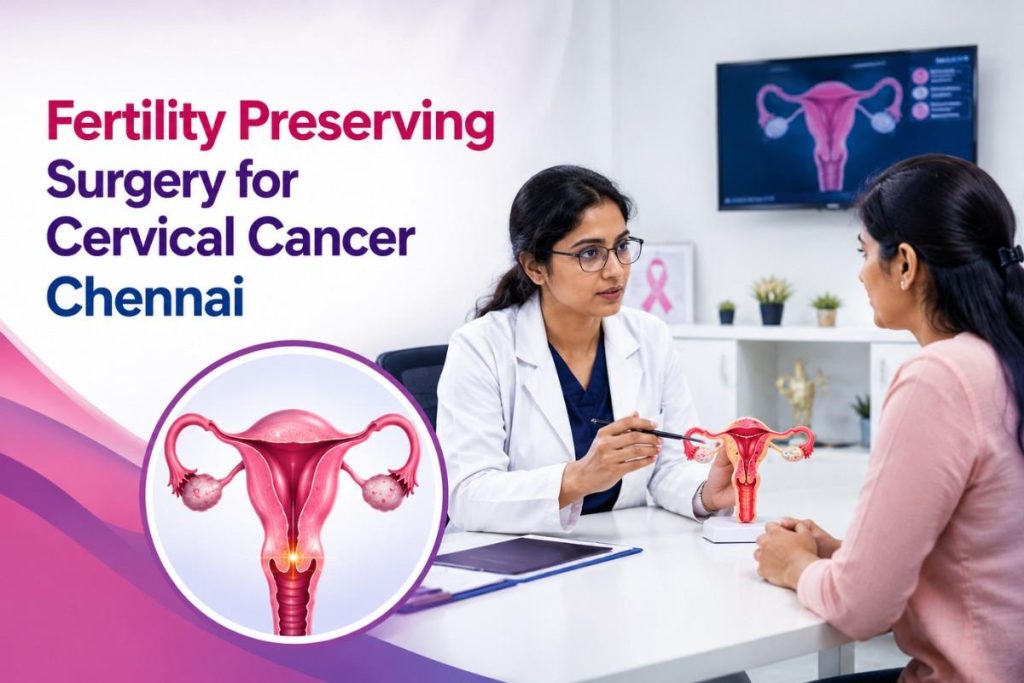
Fertility Preserving Surgery for Cervical Cancer Chennai She was twenty-eight, recently married, and had been putting off a long-delayed Pap smear for almost two years. When the results came back abnormal and a biopsy confirmed early cervical cancer, the first question she asked her doctor wasn’t about survival. It was whether she could still have children. For women in this situation searching for fertility preserving surgery for cervical cancer in Chennai, that question deserves a real answer, not a vague one. Understanding Fertility Sparing Cancer Treatment for Cervical Cancer Cervical cancer begins in the cells of the cervix, the lower part of the uterus that connects to the vagina. When it’s caught at an early stage, before it has spread beyond the cervix, treatment options can sometimes go beyond the standard approach of removing the uterus entirely. Fertility sparing cancer treatment refers to surgical approaches designed to remove the cancer while preserving the uterus, so that pregnancy may still be possible afterward. This isn’t an option for everyone. It depends on the size of the tumour, how deep it has grown, the specific type of cervical cancer, and a careful assessment of how the cancer is behaving. One of the procedures used in fertility sparing treatment is called a radical trachelectomy. This involves removing the cervix and the surrounding tissue while leaving the body of the uterus in place, along with the ovaries. It’s a more technically demanding surgery than a standard hysterectomy, and it requires very careful patient selection. Why This Matters for Women in Chennai and Tamil Nadu Cervical cancer in younger women is not as rare as people sometimes assume, and in Tamil Nadu, where regular gynecological screening isn’t always part of routine healthcare for women in their twenties and thirties, diagnoses can sometimes come later than they would with consistent Pap smear or HPV testing. When a young woman is diagnosed, the emotional weight of the conversation often centres on one question above all others. Can I have a baby after cervical cancer treatment. It’s a question that deserves to be asked directly, and answered honestly, rather than sidestepped because it feels difficult. Having access to a gynecologic oncologist in Chennai who has been specifically trained in fertility preserving techniques means that question can actually be explored properly, rather than assumed to have only one answer. Dr. Aiswarya Sekar’s Approach to Fertility Preserving Cervical Cancer Surgery Dr. Aiswarya Sekar is a Consultant Gynecologic Oncologist and Robotic Surgeon at Dr. Rela Institute and Medical Centre in Chromepet, Chennai. She completed her MCh in Gynecologic Oncology with subspecialty training at Tata Memorial Hospital, Mumbai, where fertility preserving approaches to gynecologic cancers form part of the advanced surgical curriculum. Her work in cervical cancer management includes radical surgery when needed, but also sentinel lymph node mapping and fertility sparing procedures for carefully selected early-stage cases. Sentinel lymph node mapping is a technique that helps identify whether cancer has spread to nearby lymph nodes while avoiding the removal of more nodes than necessary, which matters both for recovery and for long-term quality of life. For women who are candidates for radical trachelectomy in Chennai, the decision-making process involves detailed imaging, sometimes an examination under anaesthesia, and an honest conversation about what’s realistically achievable. Fertility preservation is never guaranteed, and Dr. Aiswarya’s approach is to be clear about that from the start, while still making sure every option that’s genuinely available to a patient is properly explored. What to Expect: Your Care Journey at Rela Hospital For a young woman facing this diagnosis, the first consultation often carries a lot of unspoken fear. Dr. Aiswarya begins by reviewing the biopsy results, imaging, and staging information, and explains in plain language what type and stage of cervical cancer is involved, since this determines which treatment paths are even on the table. If fertility preserving surgery appears to be a realistic option, further tests may be arranged at Rela Institute and Medical Centre to confirm the extent of the tumour before any final decision is made. This step matters, because committing to a fertility sparing approach only makes sense if the cancer’s characteristics genuinely support it. Once a plan is agreed upon, surgery is scheduled, and the recovery period afterward includes close monitoring along with guidance on what comes next, whether that’s routine follow-up or, eventually, conversations about family planning. For someone searching for a fertility preserving cancer surgeon near me, what often matters most isn’t just the surgery itself, but having one specialist guide the entire process from diagnosis through to these longer-term conversations. Warning Signs: When You Should See a Specialist Certain symptoms in younger women warrant a prompt visit to a gynecologic oncologist, especially if a Pap smear or HPV test has been abnormal or overdue. These include: Abnormal vaginal bleeding, including bleeding between periods or after intercourse An abnormal Pap smear or positive HPV test result Unusual vaginal discharge that is persistent or has an unusual odour Pelvic pain that doesn’t have an obvious cause A visible growth or sore on the cervix noted during a routine exam A cervical biopsy result showing abnormal or cancerous cells Always consult a qualified medical professional for diagnosis and treatment. Self-diagnosis based on online information is never a substitute for a clinical evaluation. Closing and CTA Facing a cervical cancer diagnosis at a young age, while also worrying about your future family, is an enormous amount to carry at once. Asking whether fertility preservation is possible is not a distraction from your treatment. It’s part of it. Dr. Aiswarya Sekar sees patients for exactly these conversations at Dr. Rela Institute and Medical Centre in Chromepet, Chennai. You can call the clinic or use the website’s contact page to arrange an OPD appointment, and bring every question with you. Medically reviewed by Dr. Aiswarya Sekar, Gynecologic Oncologist and Robotic Surgeon, Dr. Rela Institute and Medical Centre, Chennai Rencent Blogs. Endometrial Cancer Specialist Chennai – Dr Aiswarya Best Robotic Surgeon for Ovarian Cancer