
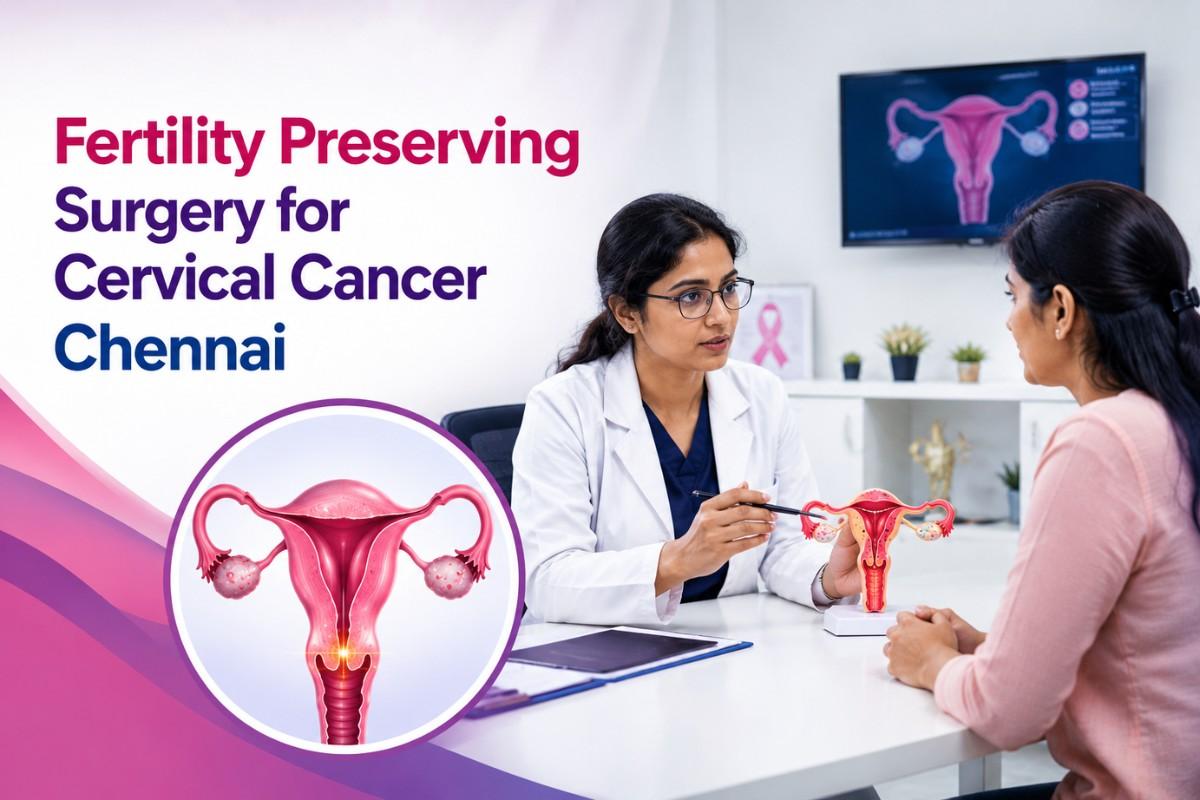
She was twenty-eight, recently married, and had been putting off a long-delayed Pap smear for almost two years. When the results came back abnormal and a biopsy confirmed early cervical cancer, the first question she asked her doctor wasn’t about survival. It was whether she could still have children. For women in this situation searching for fertility preserving surgery for cervical cancer in Chennai, that question deserves a real answer, not a vague one.
Understanding Fertility Sparing Cancer Treatment for Cervical Cancer
Cervical cancer begins in the cells of the cervix, the lower part of the uterus that connects to the vagina. When it’s caught at an early stage, before it has spread beyond the cervix, treatment options can sometimes go beyond the standard approach of removing the uterus entirely.
Fertility sparing cancer treatment refers to surgical approaches designed to remove the cancer while preserving the uterus, so that pregnancy may still be possible afterward. This isn’t an option for everyone. It depends on the size of the tumour, how deep it has grown, the specific type of cervical cancer, and a careful assessment of how the cancer is behaving.
One of the procedures used in fertility sparing treatment is called a radical trachelectomy. This involves removing the cervix and the surrounding tissue while leaving the body of the uterus in place, along with the ovaries. It’s a more technically demanding surgery than a standard hysterectomy, and it requires very careful patient selection.
Why This Matters for Women in Chennai and Tamil Nadu
Cervical cancer in younger women is not as rare as people sometimes assume, and in Tamil Nadu, where regular gynecological screening isn’t always part of routine healthcare for women in their twenties and thirties, diagnoses can sometimes come later than they would with consistent Pap smear or HPV testing.
When a young woman is diagnosed, the emotional weight of the conversation often centres on one question above all others. Can I have a baby after cervical cancer treatment. It’s a question that deserves to be asked directly, and answered honestly, rather than sidestepped because it feels difficult. Having access to a gynecologic oncologist in Chennai who has been specifically trained in fertility preserving techniques means that question can actually be explored properly, rather than assumed to have only one answer.
Dr. Aiswarya Sekar's Approach to Fertility Preserving Cervical Cancer Surgery
Dr. Aiswarya Sekar is a Consultant Gynecologic Oncologist and Robotic Surgeon at Dr. Rela Institute and Medical Centre in Chromepet, Chennai. She completed her MCh in Gynecologic Oncology with subspecialty training at Tata Memorial Hospital, Mumbai, where fertility preserving approaches to gynecologic cancers form part of the advanced surgical curriculum.
Her work in cervical cancer management includes radical surgery when needed, but also sentinel lymph node mapping and fertility sparing procedures for carefully selected early-stage cases. Sentinel lymph node mapping is a technique that helps identify whether cancer has spread to nearby lymph nodes while avoiding the removal of more nodes than necessary, which matters both for recovery and for long-term quality of life.
For women who are candidates for radical trachelectomy in Chennai, the decision-making process involves detailed imaging, sometimes an examination under anaesthesia, and an honest conversation about what’s realistically achievable. Fertility preservation is never guaranteed, and Dr. Aiswarya’s approach is to be clear about that from the start, while still making sure every option that’s genuinely available to a patient is properly explored.
What to Expect: Your Care Journey at Rela Hospital
For a young woman facing this diagnosis, the first consultation often carries a lot of unspoken fear. Dr. Aiswarya begins by reviewing the biopsy results, imaging, and staging information, and explains in plain language what type and stage of cervical cancer is involved, since this determines which treatment paths are even on the table.
If fertility preserving surgery appears to be a realistic option, further tests may be arranged at Rela Institute and Medical Centre to confirm the extent of the tumour before any final decision is made. This step matters, because committing to a fertility sparing approach only makes sense if the cancer’s characteristics genuinely support it.
Once a plan is agreed upon, surgery is scheduled, and the recovery period afterward includes close monitoring along with guidance on what comes next, whether that’s routine follow-up or, eventually, conversations about family planning. For someone searching for a fertility preserving cancer surgeon near me, what often matters most isn’t just the surgery itself, but having one specialist guide the entire process from diagnosis through to these longer-term conversations.
Warning Signs: When You Should See a Specialist
Certain symptoms in younger women warrant a prompt visit to a gynecologic oncologist, especially if a Pap smear or HPV test has been abnormal or overdue. These include:
- Abnormal vaginal bleeding, including bleeding between periods or after intercourse
- An abnormal Pap smear or positive HPV test result
- Unusual vaginal discharge that is persistent or has an unusual odour
- Pelvic pain that doesn’t have an obvious cause
- A visible growth or sore on the cervix noted during a routine exam
- A cervical biopsy result showing abnormal or cancerous cells
Always consult a qualified medical professional for diagnosis and treatment. Self-diagnosis based on online information is never a substitute for a clinical evaluation.
Closing and CTA
Facing a cervical cancer diagnosis at a young age, while also worrying about your future family, is an enormous amount to carry at once. Asking whether fertility preservation is possible is not a distraction from your treatment. It’s part of it. Dr. Aiswarya Sekar sees patients for exactly these conversations at Dr. Rela Institute and Medical Centre in Chromepet, Chennai. You can call the clinic or use the website’s contact page to arrange an OPD appointment, and bring every question with you.
Rencent Blogs.
-
Best Hospital for Gynecologic Cancer Surgery Chennai
-
Robotic Surgery Endometriosis Cancer Risk Chennai Guide
-
Post Hysterectomy Cancer Diagnosis Consultation Chennai
-
Choosing Surgeon for Gynecologic Cancer Surgery Chennai
-
Robotic Surgery Uterine Cancer Chennai: Fibroid or Cancer?
-
Fertility Preserving Ovarian Cancer Treatment in Chennai
-
Advanced Ovarian Cancer Treatment Specialist in Chennai
-
Lynch Syndrome Uterine Cancer Consultation in Chennai Explained
-
Endometrial Cancer Symptoms: When to See a Doctor in Chennai
-
Robotic Surgery for Gynecologic Cancer Cost in Chennai