She’d managed her endometriosis pain for years, timing her days around it, learning which positions helped and which made it worse. Then a routine scan showed a cyst that looked different from the ones she’d had before, and her gynecologist mentioned, almost in passing, that it should be checked further. That offhand comment is often what sends a patient searching for robotic surgery endometriosis cancer risk Chennai specialists who can explain what “checked further” actually means.
Endometriosis Ovarian Cancer Link: Separating Fact From Fear
Endometriosis is a condition where tissue similar to the uterine lining grows outside the uterus, most commonly on the ovaries, fallopian tubes, or pelvic lining, causing pain, inflammation, and sometimes fertility difficulties. It affects a meaningful number of women during their reproductive years and is, in the overwhelming majority of cases, a chronic but non-cancerous condition.
Research has identified an association between certain forms of endometriosis, particularly long-standing ovarian endometriomas, and a modestly increased risk of specific ovarian cancer subtypes. It’s important to be precise about what this means. Having endometriosis does not mean you will develop cancer. The link describes a statistical association observed across large patient populations, not a personal prediction for any individual woman.
What matters clinically is recognising when an endometrioma or pelvic mass has features that warrant closer evaluation, rather than assuming every case needs urgent concern or, at the other extreme, dismissing every follow-up recommendation as unnecessary caution.
This is where a lot of patient anxiety gets stuck. Many women with endometriosis have already had years of being told their pain is “normal” or “just part of having a uterus,” so when a doctor suddenly suggests closer monitoring, it can feel like a whiplash from being dismissed to being alarmed. Neither extreme serves the patient well. What actually helps is a clear, individualised read of the imaging in front of a specialist trained to tell the difference.
Why This Matters for Women in Chennai and Tamil Nadu
Endometriosis remains widely under-diagnosed and under-discussed across Chennai and Tamil Nadu, often dismissed for years as ordinary period pain before a proper evaluation happens. That delay means many women reach a point of needing specialist input only after living with unmanaged symptoms for a long stretch of time, sometimes with cysts or growths that have gone unmonitored in the interim.
If you’ve been asking whether endometriosis can turn into cancer, a doctor consultation in Chennai should involve someone who can assess your specific imaging and history rather than answer the question in the abstract. Having a fellowship-trained gynecologic oncologist available locally means that when a scan does raise a flag, you can get a proper evaluation without the added stress of travelling to another city while already anxious about what the finding might mean.
For many women in Tamil Nadu, the nearest specialist with this specific combination of endometriosis surgical expertise and oncology training used to be several hours away by road or rail. That distance discouraged follow-up, especially for women managing work and family responsibilities who couldn’t easily take time off for a distant consultation. A local specialist removes that barrier entirely, making it realistic to get monitored the way the situation actually calls for.
Dr. Aiswarya Sekar's Approach and Expertise
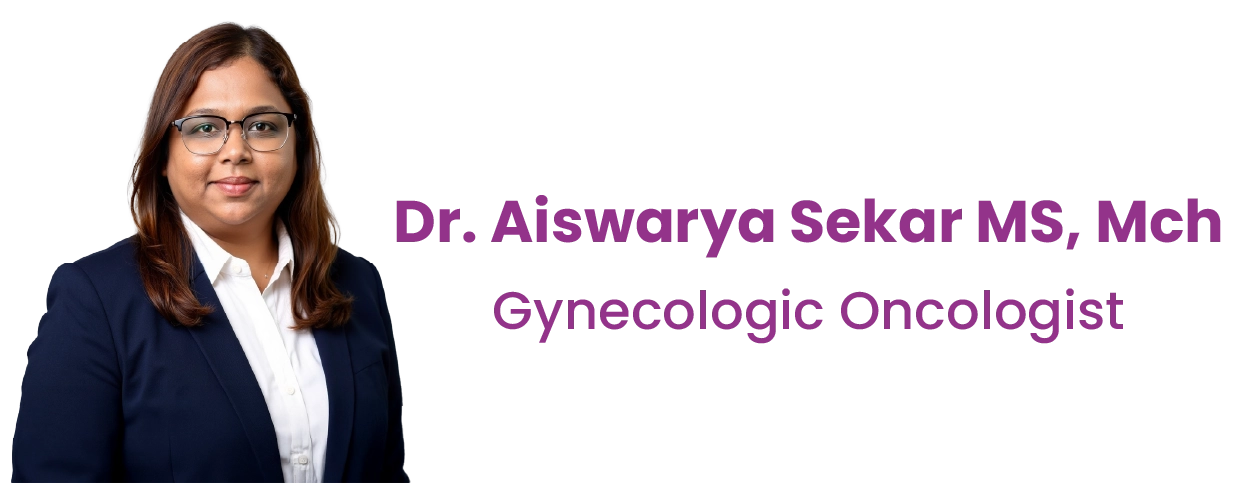
Dr. Aiswarya Sekar’s training at Tata Memorial Hospital in Mumbai gave her direct exposure to the full range of endometriosis-related presentations, from straightforward benign cases to the rarer instances where malignant transformation was confirmed. That range of experience shapes how she evaluates each patient at Dr. Rela Institute and Medical Centre in Chromepet rather than relying on a one-size-fits-all protocol.
As a robotic excision surgeon Chennai patients are increasingly referred to, she uses robotic technique for endometriosis excision because it allows for more precise removal of affected tissue while preserving healthy ovarian and pelvic structures, particularly important for women who haven’t completed their families. For those researching the best robotic surgeon for endometriosis with cancer risk features on imaging, her approach combines careful pre-surgical evaluation with intraoperative decision-making, so surgery addresses exactly what’s needed without over-treating or under-treating the finding.
Fertility preservation remains a central consideration throughout, discussed openly with each patient rather than treated as a secondary concern once the surgical plan is already set.
She also pays close attention to how endometriosis surgery is sequenced when a cancer risk feature is present. Removing an endometrioma without disturbing surrounding healthy ovarian tissue requires a different level of surgical care than a standard cyst removal, and getting that balance right is part of what distinguishes an oncology-trained surgical approach from a routine gynecological one.
What to Expect: Your Care Journey at Rela Hospital
Your first visit typically involves a detailed review of your endometriosis history, current symptoms, and recent imaging. If your scan shows features that need further assessment, Dr. Aiswarya will usually recommend additional targeted imaging or blood markers before deciding on next steps, rather than jumping straight to surgery.
This step-by-step approach exists precisely to avoid two common pitfalls: rushing into surgery for something that turns out to be entirely benign, and delaying evaluation for something that genuinely needs attention. Patients are talked through each recommendation and the reasoning behind it, so the process never feels like a black box.
Many patients wonder when to see oncologist for endometriosis Chennai concerns specifically, versus continuing with a general gynecologist. As a general guide, a referral to gynecologic oncology becomes appropriate when imaging shows an atypical or rapidly changing mass, when a patient has risk factors such as a strong family history, or when a general gynecologist has flagged something outside routine endometriosis findings. If surgery is recommended, you’ll be walked through what the robotic procedure involves, expected recovery, and what happens if anything unexpected is found during the operation itself.
Follow-up care includes pathology review and a clear discussion of results, with next steps mapped out based on what the tissue analysis actually shows. Whether that means a return to routine endometriosis management or a referral into oncology treatment, you leave each appointment knowing exactly what happens next rather than waiting anxiously for a callback.
Warning Signs: When You Should See a Specialist
If you have endometriosis and notice any of the following, a gynecologic oncology evaluation is worth pursuing:
An ovarian cyst or endometrioma that has grown significantly since your last scan
New or worsening pelvic pain that differs from your usual endometriosis pattern
Imaging findings described as complex, solid, or irregular rather than simple
Unexplained bloating or abdominal swelling alongside known endometriosis
A personal or family history of ovarian, breast, or uterine cancer
Postmenopausal symptoms in someone with a known history of endometriosis
Always consult a qualified medical professional for diagnosis and treatment. Self-diagnosis based on online information is never a substitute for a clinical evaluation.
Living with endometriosis already takes a certain kind of resilience, and hearing that a finding needs further evaluation can feel like an unfair additional weight to carry. You don’t have to sit with that uncertainty alone. Dr. Aiswarya Sekar and her team at Dr. Rela Institute and Medical Centre in Chromepet, Chennai, can review your imaging and history to give you clear, honest answers about what you’re facing. Book a consultation or reach the OPD to take that next step, whenever you feel ready for it.
Rencent Blogs.
-
Best Hospital for Gynecologic Cancer Surgery Chennai
-
Robotic Surgery Endometriosis Cancer Risk Chennai Guide
-
Post Hysterectomy Cancer Diagnosis Consultation Chennai
-
Choosing Surgeon for Gynecologic Cancer Surgery Chennai
-
Robotic Surgery Uterine Cancer Chennai: Fibroid or Cancer?
-
Fertility Preserving Ovarian Cancer Treatment in Chennai
-
Advanced Ovarian Cancer Treatment Specialist in Chennai
-
Lynch Syndrome Uterine Cancer Consultation in Chennai Explained
-
Endometrial Cancer Symptoms: When to See a Doctor in Chennai
-
Robotic Surgery for Gynecologic Cancer Cost in Chennai