
Lakshmi’s biopsy report confirmed early-stage cervical cancer, and within days she found herself comparing two very different accounts online. One website described robotic surgery as faster recovery and smaller scars. Another mentioned something about a trial that changed how doctors think about robotic cervical cancer surgery altogether. Caught between the two, she didn’t know which to trust. If you are researching cervical cancer surgery in Chennai right now, you deserve a straight answer, not marketing language dressed up as medical advice.
Understanding Radical Hysterectomy for Cervical Cancer
Radical hysterectomy is the standard surgical treatment for early-stage cervical cancer. Unlike a simple hysterectomy, it removes the uterus along with surrounding tissue, the upper part of the vagina, and nearby lymph nodes, because cervical cancer can spread into these areas even when it looks confined on a scan.
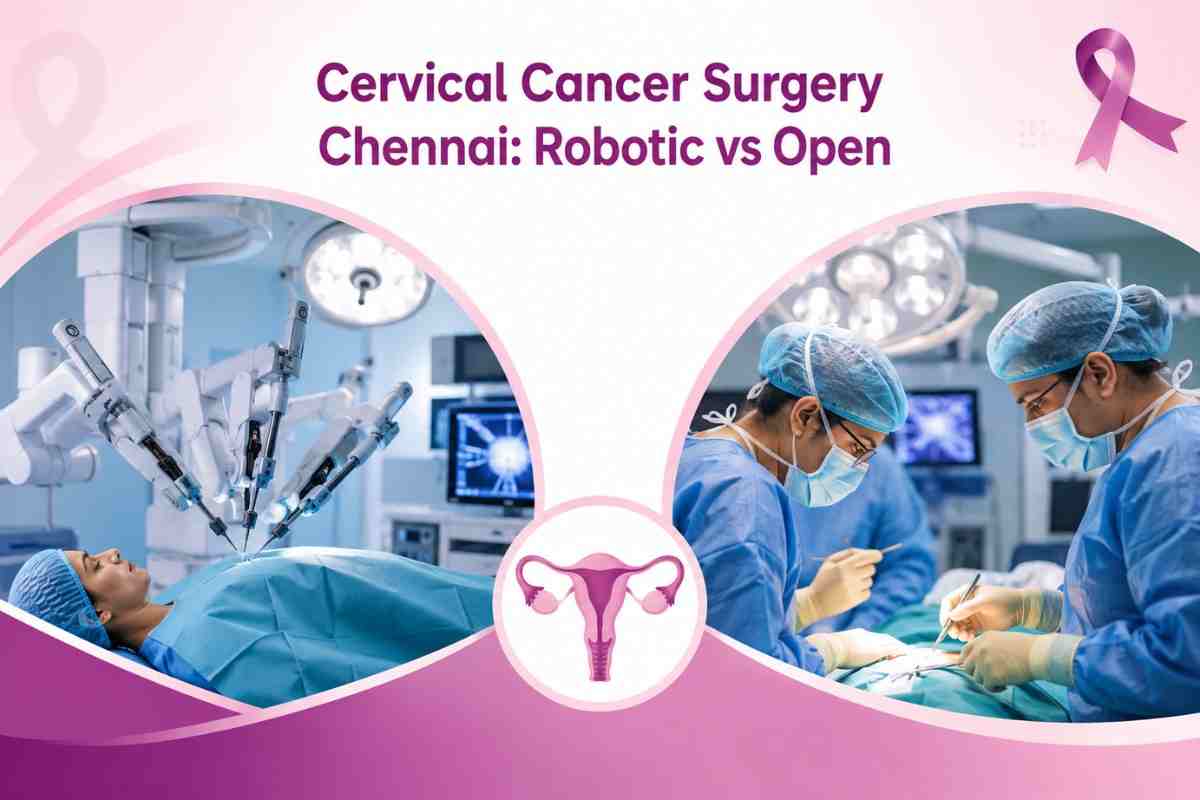
This surgery can be performed two ways. Open surgery uses a single abdominal incision, giving the surgeon direct access to the pelvis. Robotic or minimally invasive surgery uses several small incisions and a robotic surgical system, offering smaller scars and often a shorter hospital stay.
Here is the part many websites leave out, and it matters. A large international trial published in 2018 found that minimally invasive radical hysterectomy, including robotic surgery, was associated with lower survival rates than open surgery specifically for early-stage cervical cancer. That finding changed global treatment guidelines almost overnight. It does not mean robotic surgery is unsafe in general. It means that for this particular cancer and this particular operation, the evidence currently favours the open approach.
This is not the case for every gynecologic cancer. Robotic surgery remains the preferred, well-supported approach for many endometrial and early ovarian cancer cases, where the evidence points in the opposite direction. The confusion online largely comes from applying findings about one cancer type to a completely different one, which is exactly the kind of generalisation a proper cervical cancer surgery Chennai consultation should correct rather than repeat.
Recovery differences between the two approaches are real but should be weighed against safety, not instead of it. Open surgery typically involves a longer hospital stay, usually four to six days, and a longer return to full activity, often six weeks or more. Robotic surgery can shorten both considerably. For cervical cancer, though, the honest starting point of the conversation has to be survival outcomes first, with recovery discussed as a secondary factor once the safer approach for your specific stage has been identified.
Why This Matters for Women in Chennai and Tamil Nadu
This distinction matters enormously in a market where robotic surgery is often marketed as automatically superior. Women in Chennai searching for the best hospital for cervical cancer surgery in Chennai deserve a surgeon who will tell them when minimally invasive surgery is not the safer option, not one who defaults to robotics because it sounds more advanced.
Cervical cancer also tends to affect women at a somewhat younger age than other gynecologic cancers, often while they are still raising young children or building a career. Getting the surgical approach right the first time, rather than needing to revisit treatment later, carries weight that goes beyond the operation itself.
Access to a gynecologic oncologist who understands this specific evidence, rather than a general surgeon extrapolating from other cancer types, is not always guaranteed outside major cancer centres. Having that expertise available locally in Chennai means women do not have to choose between getting the right surgical advice and getting it close to home.
For families travelling in from smaller towns across Tamil Nadu, this local availability changes the entire experience of a cervical cancer diagnosis. Instead of a rushed referral to a distant metro city and an unfamiliar system, a proper cervical cancer surgery Chennai consultation can happen within days, with the same specialist available for every follow-up visit afterward.
Dr. Aiswarya Sekar's Approach and Expertise
Dr. Aiswarya Sekar is a Consultant Gynecologic Oncologist and Robotic Surgeon at Dr. Rela Institute and Medical Centre in Chromepet, Chennai, trained in Gynecologic Oncology at Tata Memorial Hospital, Mumbai. Her practice includes both robotic and open surgical techniques, which means the decision for any individual patient is based on the specific cancer, not on which equipment happens to be available that day.
For cervical cancer specifically, she follows current evidence-based guidelines that favour open radical hysterectomy for most early-stage cases, discussing this openly with patients rather than assuming they want the less invasive option by default. Robotic surgery vs open surgery for cervical cancer, which is safer, is a question she addresses directly during consultation, using the patient’s own scans and staging rather than general statements.
Where fertility preservation is medically appropriate for very early, carefully selected cases, her training allows that conversation to happen as well, always framed by what the evidence actually supports rather than what a patient might hope to hear.
What to Expect: Your Care Journey at Rela Hospital
Your first visit typically involves a detailed review of your biopsy results, imaging, and cancer staging, since the recommended surgical approach depends heavily on how early the cancer was caught and how far it may have spread.
From there, Dr. Aiswarya explains the recommended approach in plain terms, including why open or robotic surgery is being suggested for your specific case. If cervical cancer surgery cost and recovery in Chennai is a practical concern for your family, this is also the point where realistic timelines and expectations are discussed, so you can plan around work, childcare, or travel from outside the city if needed.
Surgery is scheduled once staging is confirmed, and recovery is monitored closely afterward, with follow-up visits structured around your pathology results and any additional treatment, such as radiation, that your case might require. Throughout this process, questions are welcomed at every stage rather than saved for a single rushed appointment before surgery.
Warning Signs: When You Should See a Specialist
The following symptoms warrant a prompt evaluation by a gynecologic oncologist rather than a general practitioner alone.
- Bleeding after intercourse or between periods
- Unusual vaginal discharge, especially if it is watery, bloody, or foul-smelling
- Pelvic pain that persists or worsens over several weeks
- Bleeding after menopause
- An abnormal Pap smear or HPV test result that has not yet been fully investigated
- A previous cervical cancer diagnosis with new or returning symptoms
Always consult a qualified medical professional for diagnosis and treatment. Self-diagnosis based on online information is never a substitute for a clinical evaluation.
Closing and Next Steps
Choosing between robotic and open surgery is not something you should have to figure out from conflicting websites while frightened and short on time. You deserve a specialist who will explain the evidence honestly, even when it means recommending the option that sounds less modern.
If you are weighing your options for cervical cancer surgery, Dr. Aiswarya Sekar sees patients at Dr. Rela Institute and Medical Centre in Chromepet, Chennai. You can call the hospital to book an OPD appointment and bring your existing reports for review. You do not have to make this decision alone.
Rencent Blogs.
-
Best Hospital for Gynecologic Cancer Surgery Chennai
-
Robotic Surgery Endometriosis Cancer Risk Chennai Guide
-
Post Hysterectomy Cancer Diagnosis Consultation Chennai
-
Choosing Surgeon for Gynecologic Cancer Surgery Chennai
-
Robotic Surgery Uterine Cancer Chennai: Fibroid or Cancer?
-
Fertility Preserving Ovarian Cancer Treatment in Chennai
-
Advanced Ovarian Cancer Treatment Specialist in Chennai
-
Lynch Syndrome Uterine Cancer Consultation in Chennai Explained
-
Endometrial Cancer Symptoms: When to See a Doctor in Chennai
-
Robotic Surgery for Gynecologic Cancer Cost in Chennai