
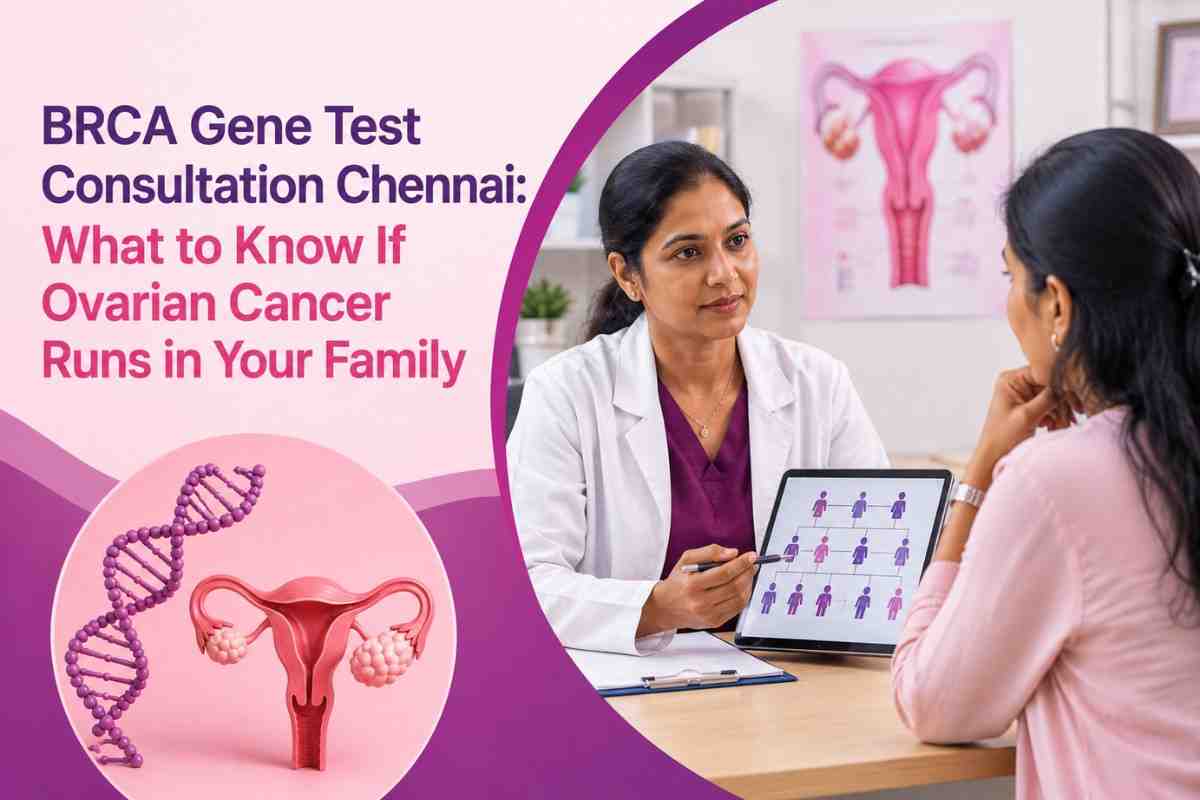
Meera was thirty-four when her mother was diagnosed with ovarian cancer for the second time. Sitting in the waiting room at a Chennai hospital, she found herself wondering something she had never said out loud before: could this happen to her too. That question is exactly what brings many women to a BRCA gene test consultation in Chennai, and it is a question worth taking seriously rather than pushing aside.
Understanding Hereditary Ovarian Cancer Screening
BRCA1 and BRCA2 are genes that everyone carries. Their normal job is to help repair damaged DNA in your cells. In some families, however, one of these genes carries a mutation passed down from a parent, and that mutation significantly raises the lifetime risk of ovarian and breast cancer.
A BRCA gene test is a simple blood or saliva sample that checks for these inherited mutations. It does not diagnose cancer. It tells you whether you carry a higher genetic risk, which is a very different thing. Hereditary ovarian cancer screening exists precisely for this reason, to give women and their families clear information before symptoms ever appear, so decisions can be made calmly rather than in crisis.
This is where a proper BRCA gene test consultation matters more than the test itself. A lab report on its own can be confusing, even frightening, if nobody explains what the numbers actually mean for your specific situation. A consultation puts the result in context, weighing your age, your family tree, and the type of cancers that have appeared in it.
Genetic counselling is the part of this process that often gets skipped, and it should not be. Before and after the test, a specialist walks you through what a positive or negative result would actually mean for you, for your sisters, and for your daughters. Numbers on a report mean little without someone to interpret them in the context of your own family history.
Not every woman with a family history of cancer needs testing, and not every negative result means the conversation ends there. This is precisely why BRCA1 BRCA2 genetic counselling is treated as a process rather than a single appointment. It usually spans an initial risk assessment, the test itself if recommended, and a results discussion that maps out practical next steps.
Why This Matters for Women in Chennai and Tamil Nadu
Ovarian cancer is frequently caught late in India, partly because early symptoms are vague and partly because genetic risk conversations rarely happen at the family clinic level. For a long time, women in Tamil Nadu who wanted proper hereditary cancer screening had to travel to Mumbai or Delhi for a specialist opinion.
That gap has narrowed. Where to get BRCA gene testing in Chennai is now a question with a real, local answer, because fellowship-trained gynecologic oncologists are practising here with the same training standards found at India’s leading cancer centres. This matters for a very practical reason: a woman who has just watched a parent go through cancer treatment does not need the added burden of travelling to another city for a conversation about her own risk.
Local access also changes how early these conversations happen. When testing and counselling are available close to home, women are more likely to act on family history before it becomes an emergency, rather than after. A BRCA gene test consultation in Chennai that includes proper genetic counselling, rather than just a lab requisition, gives Tamil Nadu families the same standard of preventive oncology care that was once available only in Mumbai or Delhi.
Cultural factors also play a role here. Conversations about a mother’s or aunt’s cancer diagnosis are not always easy to bring up at home, and many women carry this question privately for years before acting on it. Having a specialist in the city who understands both the clinical and the personal weight of that question makes it easier to finally ask.
Dr. Aiswarya Sekar's Approach and Expertise
Dr. Aiswarya Sekar is a Consultant Gynecologic Oncologist and Robotic Surgeon at Dr. Rela Institute and Medical Centre in Chromepet, Chennai. She trained in Gynecologic Oncology at Tata Memorial Hospital, Mumbai, one of the very few centres in the country where oncologists work daily with hereditary cancer syndromes, including BRCA1 and BRCA2 mutations.
That background shapes how she approaches every consultation on this topic. Should I get tested for BRCA if my mother had ovarian cancer is one of the most common questions she hears, and her answer is never a blanket yes or no. It depends on the specific family history, the age at diagnosis of affected relatives, and other factors that a proper risk assessment brings out.
For women who do carry a BRCA mutation and later require surgery, her training in fertility-preserving oncologic techniques and robotic surgery means treatment planning can weigh both cancer risk and a woman’s future fertility, rather than treating one automatically at the expense of the other. This combination of TMH training and hands-on robotic expertise is still uncommon in Chennai, which is part of what makes preventive oncology consultations here genuinely comprehensive rather than a referral checkbox.
What to Expect: Your Care Journey at Rela Hospital
The process usually begins with a detailed conversation, not a needle. Dr. Aiswarya first reviews your family history across at least two generations, noting who was affected, at what age, and with which type of cancer. This single step often reveals more than people expect.
If testing is recommended, a blood sample is collected at Rela Hospital and sent to an accredited genetic laboratory. Results typically take a couple of weeks. During this waiting period, you are not left guessing. A doctor for hereditary cancer risk consultation in Chennai should prepare you for what each possible outcome means, so the result itself does not land as a shock.
Once results arrive, the conversation continues. A negative result does not mean zero risk, and a positive result does not mean cancer is inevitable. It means a personalised plan follows, which may include more frequent screening, risk-reducing options, or simply a clearer picture to share with siblings and children who may also want testing. Follow-up is built into the process, not treated as an afterthought.
For many patients, this is the real value of a BRCA gene test consultation Chennai families can access without leaving the city. It is not a one-time transaction between a needle and a report. It is an ongoing relationship with a specialist who remains available as new questions come up, sometimes months or years after the original result.
Warning Signs: When You Should See a Specialist
Certain symptoms and situations warrant a specialist opinion sooner rather than later.
- Persistent bloating or abdominal discomfort lasting more than two to three weeks
- Unexplained changes in bowel or bladder habits
- Pelvic or abdominal pain that does not resolve
- A close relative diagnosed with ovarian or breast cancer, especially before age fifty
- Multiple family members on the same side affected by breast or ovarian cancer
- A known BRCA mutation already identified in your family
Always consult a qualified medical professional for diagnosis and treatment. Self-diagnosis based on online information is never a substitute for a clinical evaluation.
Closing and Next Steps
Asking about your own genetic risk after watching a parent or sibling go through cancer takes a kind of quiet courage that is easy to underestimate. You do not need to have all the answers before you walk in the door.
If you are considering a BRCA gene test consultation in Chennai, Dr. Aiswarya Sekar sees patients at Dr. Rela Institute and Medical Centre in Chromepet. You can call the hospital to book an OPD appointment or request a genetic risk consultation. Whatever your family history looks like, having an honest, unhurried conversation about it is a reasonable first step, and one you do not have to take alone.
Rencent Blogs.
-
Best Hospital for Gynecologic Cancer Surgery Chennai
-
Robotic Surgery Endometriosis Cancer Risk Chennai Guide
-
Post Hysterectomy Cancer Diagnosis Consultation Chennai
-
Choosing Surgeon for Gynecologic Cancer Surgery Chennai
-
Robotic Surgery Uterine Cancer Chennai: Fibroid or Cancer?
-
Fertility Preserving Ovarian Cancer Treatment in Chennai
-
Advanced Ovarian Cancer Treatment Specialist in Chennai
-
Lynch Syndrome Uterine Cancer Consultation in Chennai Explained
-
Endometrial Cancer Symptoms: When to See a Doctor in Chennai
-
Robotic Surgery for Gynecologic Cancer Cost in Chennai