
Best Hospital for Gynecologic Cancer Surgery Chennai
Best Hospital for Gynecologic Cancer Surgery Chennai Her family had already started asking around. A cousin’s colleague knew someone who’d had surgery at one place, an aunt swore by another, and every suggestion came wrapped in good intentions but no real way to compare them. Somewhere in that noise, she typed the question plainly into her phone: what’s the best hospital for gynecologic cancer surgery Chennai actually has to offer, and how is anyone supposed to know? Rela Institute Gynecologic Oncology: What Sets a Specialist Department Apart A hospital’s gynecologic oncology department isn’t defined by the size of the building or the length of its patient list. It’s defined by whether the surgeons on staff are specifically trained in cancer surgery, whether the facility has the equipment and support teams to manage complex cases, and whether care is coordinated across surgery, pathology, and oncology rather than scattered across separate departments that don’t talk to each other. At Dr. Rela Institute and Medical Centre, the gynecologic oncology department centres around fellowship-trained specialists working alongside pathology and medical oncology teams under one roof. That structure matters more than it might seem at first. When a biopsy result needs urgent review, or when a surgical plan needs input from a radiation oncologist, the distance between departments, literally and administratively, affects how quickly and accurately a patient’s care moves forward. For a family trying to evaluate where to go, the honest answer isn’t a single “best” institution in any absolute sense. It’s whichever hospital has the specific combination of trained specialists, technology, and coordinated care that your situation requires. That’s a harder answer to sit with than a simple ranking, but it’s the more useful one. A hospital that’s excellent for cardiac care isn’t automatically the right choice for a complex ovarian cancer staging surgery, and a large multi-specialty brand name doesn’t guarantee a fellowship-trained gynecologic oncologist is actually on staff. The right question isn’t which hospital is biggest or best known. It’s which one has the specific expertise your diagnosis calls for. Why This Matters for Women in Chennai and Tamil Nadu For a long time, families across Tamil Nadu treated a serious gynecologic cancer diagnosis as an automatic reason to travel to Mumbai or Delhi, assuming that specialist-level care simply wasn’t available closer to home. That assumption cost people time, money, and the comfort of being near family during treatment, often for a level of care that has since become available locally. Patients asking which hospital is best for gynecologic cancer surgery in Chennai are often really asking a narrower, more useful question: does this city have surgeons trained the way the top national centres train theirs. It does now. Reading through Rela Institute robotic cancer surgery reviews and patient accounts, a pattern emerges of women who once assumed they’d need to leave the state discovering they didn’t have to. Chennai has become one of the cities worth including when people compare top cancer surgery hospitals across South India for women, rather than an afterthought on that list. Dr. Aiswarya Sekar’s Approach and Expertise Dr. Aiswarya Sekar’s MCh in Gynecologic Oncology from Tata Memorial Hospital in Mumbai places her training on par with the country’s most respected cancer surgery programs. She brings that background to Dr. Rela Institute and Medical Centre in Chromepet, where she practises as a robotic gynecologic oncosurgeon handling a full range of gynecologic cancer cases. Her use of robotic surgical technique allows for more precise tumour removal and lymph node staging with smaller incisions than traditional open surgery, translating into a generally smoother recovery for patients. She’s also become a resource for patients whose concerns extend beyond a confirmed cancer diagnosis. Someone searching for the best robotic surgeon for endometriosis with cancer risk, for instance, or wondering when to see an oncologist for endometriosis in Chennai, often ends up at the same department, since the surgical precision and oncology judgment required overlap significantly with cancer surgery itself. What distinguishes her approach isn’t a single technique but a consistent philosophy: treat the specific patient and pathology in front of her, not a generalised protocol. That philosophy also shows up in how she communicates. Surgical terms get explained the first time they’re used, not assumed as common knowledge, and patients are given room to ask the same question twice if the first answer didn’t fully land. For a diagnosis this significant, that patience isn’t a nicety. It’s part of the care itself. What to Expect: Your Care Journey at Rela Hospital Your first consultation typically involves a thorough review of your existing reports, imaging, and symptoms, followed by a clear explanation of what further testing, if any, is needed before a treatment plan can be finalised. Nothing moves forward without you understanding why. If surgery is recommended, you’ll be walked through whether a robotic approach fits your case, what the procedure involves, and what recovery typically looks like. The gynecologic oncology department at RIMC coordinates directly with pathology for rapid results and with medical oncology should additional treatment be needed after surgery, so you aren’t left managing referrals between disconnected specialists on your own. Follow-up care continues on a structured schedule well past your surgical recovery, with the same team tracking your progress rather than handing you off elsewhere once the operation is behind you. That continuity extends to the small logistical details that often get overlooked when comparing hospitals on paper: how quickly a report actually gets shared with you, whether a nurse coordinator is reachable between visits, and whether questions that come up at home get answered before your next scheduled appointment. These details rarely appear in a hospital brochure, but they shape the day-to-day experience of treatment far more than most patients expect going in. Warning Signs: When You Should See a Specialist Regardless of which hospital you’re considering, certain symptoms warrant a gynecologic oncology consultation without delay: Bleeding after menopause, even a single episode
Robotic Surgery Endometriosis Cancer Risk Chennai Guide
Robotic Surgery Endometriosis Cancer Risk Chennai Guide She’d managed her endometriosis pain for years, timing her days around it, learning which positions helped and which made it worse. Then a routine scan showed a cyst that looked different from the ones she’d had before, and her gynecologist mentioned, almost in passing, that it should be checked further. That offhand comment is often what sends a patient searching for robotic surgery endometriosis cancer risk Chennai specialists who can explain what “checked further” actually means. Endometriosis Ovarian Cancer Link: Separating Fact From Fear Endometriosis is a condition where tissue similar to the uterine lining grows outside the uterus, most commonly on the ovaries, fallopian tubes, or pelvic lining, causing pain, inflammation, and sometimes fertility difficulties. It affects a meaningful number of women during their reproductive years and is, in the overwhelming majority of cases, a chronic but non-cancerous condition. Research has identified an association between certain forms of endometriosis, particularly long-standing ovarian endometriomas, and a modestly increased risk of specific ovarian cancer subtypes. It’s important to be precise about what this means. Having endometriosis does not mean you will develop cancer. The link describes a statistical association observed across large patient populations, not a personal prediction for any individual woman. What matters clinically is recognising when an endometrioma or pelvic mass has features that warrant closer evaluation, rather than assuming every case needs urgent concern or, at the other extreme, dismissing every follow-up recommendation as unnecessary caution. This is where a lot of patient anxiety gets stuck. Many women with endometriosis have already had years of being told their pain is “normal” or “just part of having a uterus,” so when a doctor suddenly suggests closer monitoring, it can feel like a whiplash from being dismissed to being alarmed. Neither extreme serves the patient well. What actually helps is a clear, individualised read of the imaging in front of a specialist trained to tell the difference. Why This Matters for Women in Chennai and Tamil Nadu Endometriosis remains widely under-diagnosed and under-discussed across Chennai and Tamil Nadu, often dismissed for years as ordinary period pain before a proper evaluation happens. That delay means many women reach a point of needing specialist input only after living with unmanaged symptoms for a long stretch of time, sometimes with cysts or growths that have gone unmonitored in the interim. If you’ve been asking whether endometriosis can turn into cancer, a doctor consultation in Chennai should involve someone who can assess your specific imaging and history rather than answer the question in the abstract. Having a fellowship-trained gynecologic oncologist available locally means that when a scan does raise a flag, you can get a proper evaluation without the added stress of travelling to another city while already anxious about what the finding might mean. For many women in Tamil Nadu, the nearest specialist with this specific combination of endometriosis surgical expertise and oncology training used to be several hours away by road or rail. That distance discouraged follow-up, especially for women managing work and family responsibilities who couldn’t easily take time off for a distant consultation. A local specialist removes that barrier entirely, making it realistic to get monitored the way the situation actually calls for. Dr. Aiswarya Sekar’s Approach and Expertise Dr. Aiswarya Sekar’s training at Tata Memorial Hospital in Mumbai gave her direct exposure to the full range of endometriosis-related presentations, from straightforward benign cases to the rarer instances where malignant transformation was confirmed. That range of experience shapes how she evaluates each patient at Dr. Rela Institute and Medical Centre in Chromepet rather than relying on a one-size-fits-all protocol. As a robotic excision surgeon Chennai patients are increasingly referred to, she uses robotic technique for endometriosis excision because it allows for more precise removal of affected tissue while preserving healthy ovarian and pelvic structures, particularly important for women who haven’t completed their families. For those researching the best robotic surgeon for endometriosis with cancer risk features on imaging, her approach combines careful pre-surgical evaluation with intraoperative decision-making, so surgery addresses exactly what’s needed without over-treating or under-treating the finding. Fertility preservation remains a central consideration throughout, discussed openly with each patient rather than treated as a secondary concern once the surgical plan is already set. She also pays close attention to how endometriosis surgery is sequenced when a cancer risk feature is present. Removing an endometrioma without disturbing surrounding healthy ovarian tissue requires a different level of surgical care than a standard cyst removal, and getting that balance right is part of what distinguishes an oncology-trained surgical approach from a routine gynecological one. What to Expect: Your Care Journey at Rela Hospital Your first visit typically involves a detailed review of your endometriosis history, current symptoms, and recent imaging. If your scan shows features that need further assessment, Dr. Aiswarya will usually recommend additional targeted imaging or blood markers before deciding on next steps, rather than jumping straight to surgery. This step-by-step approach exists precisely to avoid two common pitfalls: rushing into surgery for something that turns out to be entirely benign, and delaying evaluation for something that genuinely needs attention. Patients are talked through each recommendation and the reasoning behind it, so the process never feels like a black box. Many patients wonder when to see oncologist for endometriosis Chennai concerns specifically, versus continuing with a general gynecologist. As a general guide, a referral to gynecologic oncology becomes appropriate when imaging shows an atypical or rapidly changing mass, when a patient has risk factors such as a strong family history, or when a general gynecologist has flagged something outside routine endometriosis findings. If surgery is recommended, you’ll be walked through what the robotic procedure involves, expected recovery, and what happens if anything unexpected is found during the operation itself. Follow-up care includes pathology review and a clear discussion of results, with next steps mapped out based on what the tissue
Post Hysterectomy Cancer Diagnosis Consultation Chennai
Post Hysterectomy Cancer Diagnosis Consultation Chennai She’d already gone home after her hysterectomy, relieved the surgery was behind her, when the phone call came. The pathology report on the removed tissue had shown something unexpected. Cancer cells, found only after the fact. In that moment, every plan for recovery paused, replaced by a single, urgent need: a post hysterectomy cancer diagnosis consultation Chennai families could trust to explain what this actually meant and what needed to happen next. Incidental Cancer Found After Hysterectomy: What It Means An incidental cancer finding happens when a hysterectomy is performed for a condition believed to be benign, such as fibroids or heavy bleeding, and the pathology lab later identifies cancerous cells in the removed uterus or surrounding tissue. It is more common than most patients realise, and it is not a sign that anything was done wrong during the original surgery. What it does mean is that the original operation likely wasn’t designed as a cancer surgery from the start, since the diagnosis wasn’t known beforehand. Cancer surgery typically involves specific staging steps, examining lymph nodes, assessing surrounding tissue, and confirming the disease hasn’t spread beyond the uterus. When those steps weren’t part of the first surgery, a second, more targeted procedure called restaging surgery is often recommended to complete that picture accurately. Hearing this news after already recovering from one surgery is disorienting. It’s normal to feel confused about why more surgery might be needed when the original tumour has technically already been removed. Some patients also feel a flash of anger at this stage, wondering whether the original diagnosis should have been caught earlier. In most cases it couldn’t have been. Certain cancers only become identifiable once the tissue is examined under a microscope after removal, and no amount of pre-surgical imaging or examination would have flagged them beforehand. That distinction matters, because it’s easy to spiral into second-guessing an earlier decision that was, at the time, entirely reasonable. Why This Matters for Women in Chennai and Tamil Nadu Hysterectomies for presumed benign conditions are performed routinely across Chennai and Tamil Nadu, often by general gynecologists rather than oncology specialists, since cancer isn’t suspected going in. When an incidental finding does occur, the patient suddenly needs a different kind of expertise than the one involved in her original surgery, and finding that expertise quickly matters. If you’re searching for what to do when cancer is found after hysterectomy in Chennai, know that this situation calls for a gynecologic oncologist specifically, not a return visit to the original surgical team unless that team includes oncology sub-specialisation. Having access to a TMH-trained gynecologic oncosurgeon locally means you don’t have to travel out of state during an already stressful and time-sensitive window, since restaging decisions are often best made without unnecessary delay. Many families in Tamil Nadu still assume that any serious cancer surgery means a trip to Mumbai or Delhi. That assumption made sense a decade ago. It makes far less sense today, when the specific fellowship training required for these cases is now available within Chennai itself, close enough that a patient can attend follow-up scans without planning an entire trip around each one. Dr. Aiswarya Sekar’s Approach and Expertise Dr. Aiswarya Sekar completed her MCh in Gynecologic Oncology at Tata Memorial Hospital in Mumbai, where restaging and completion surgeries for incidental cancer findings were part of her core clinical training. That specific experience shapes how she evaluates each case she now sees at Dr. Rela Institute and Medical Centre in Chromepet, Chennai. For patients searching for a doctor for restaging surgery after hysterectomy, her approach begins with a careful review of the original pathology report and surgical notes before recommending next steps. Not every incidental finding requires further surgery. Some cases, depending on the cancer type, grade, and how completely the original surgery addressed the area, can be managed with close monitoring instead. Where restaging is appropriate, she frequently uses robotic surgical technique, which allows for precise lymph node assessment with a comparatively easier recovery than open restaging surgery. She also takes care to explain, honestly and without minimising, what the original pathology findings mean for prognosis, since patients in this situation deserve clarity rather than vague reassurance. Because time can matter in these cases, Dr. Aiswarya’s team also works to fast-track the review process wherever possible, recognising that patients in this position are often anxious to move forward rather than sit with unanswered questions for longer than necessary. What to Expect: Your Care Journey at Rela Hospital The first consultation after an incidental cancer diagnosis usually starts with Dr. Aiswarya requesting the complete pathology slides and surgical report from your original hospital, so nothing is assessed on a summary alone. She’ll walk you through what the report actually shows, in language that doesn’t require a medical degree to follow. From there, additional imaging may be recommended to check whether further evaluation supports a restaging procedure. If surgery is advised, the plan, timeline, and recovery expectations are discussed in detail before you’re asked to decide anything. Patients are encouraged to bring their original discharge summary and any prior scans to this visit, since it speeds up the review considerably. For those looking for the best oncologist for follow up surgery Tamil Nadu wide, ongoing care at Rela continues well past any second surgery, with a structured follow-up schedule and coordination with medical oncology if additional treatment is ever needed. You are not simply handed back to your original doctor once this phase begins. The care stays connected. This continuity often ends up mattering more than patients expect at the outset. Rather than shuttling between different clinics for each new question, follow-up scans, pathology review, and any additional consultations happen within the same coordinated team, which reduces the chance of details getting lost between providers. Warning Signs: When You Should See a Specialist If you’ve had a hysterectomy
Choosing Surgeon for Gynecologic Cancer Surgery Chennai
Choosing Surgeon for Gynecologic Cancer Surgery Chennai The report came back with a word she’d never expected to read next to her own name. Malignant. Somewhere between the shock and the next appointment, a new question took over: who actually performs this kind of surgery, and how does anyone in Chennai even begin choosing surgeon for gynecologic cancer surgery Chennai families rely on when a decision this significant can’t be undone. That single question, more than any symptom, is often what brings a patient to search in the first place. Gynecologic Oncology Surgeon Credentials: What Actually Matters A general gynecologist and a gynecologic oncologist are not interchangeable, even though both may appear under similar hospital directory listings. A gynecologic oncologist completes additional fellowship training, an MCh in Gynecologic Oncology, specifically to manage cancers of the uterus, ovaries, cervix, and vulva, along with the complex staging surgeries these conditions often require. This distinction isn’t academic. A surgeon without oncology-specific training may remove a tumour without staging it correctly, which can affect what treatment comes next. Gynecologic oncology surgeon credentials worth checking include where the surgeon trained, whether that training included high-volume cancer centre exposure, and whether they’ve maintained active surgical practice in oncology specifically rather than general gynecology alone. A patient rarely has the medical background to evaluate a surgical CV line by line. What she can reasonably ask is simple: has this surgeon trained specifically in cancer surgery, and do they perform this kind of procedure regularly, not occasionally. It also helps to ask how a surgeon approaches uncertainty. Gynecologic cancers don’t always present with a textbook picture, and a specialist who trained at a high-volume centre has typically seen enough atypical cases to recognise when something doesn’t fit the usual pattern. That pattern recognition, built through repetition rather than theory, is often the difference between a straightforward recovery and a missed complication. Why This Matters for Women in Chennai and Tamil Nadu For years, a confirmed or suspected gynecologic cancer diagnosis in Chennai often meant a difficult choice: undergo surgery locally with a general gynecologist, or travel to Mumbai or Delhi for a fellowship-trained specialist. Neither option felt entirely right. Local convenience came at the cost of specialized expertise, and travel came at the cost of time, money, and the emotional toll of being far from home during treatment. If you’re trying to understand how to choose the best gynecologic cancer surgeon in Chennai, it helps to know that this gap has genuinely narrowed. Chennai now has access to fellowship-trained gynecologic oncosurgeons practicing locally, which means specialist-level surgical care no longer requires uprooting your life during an already difficult period. That shift matters enormously for women across Tamil Nadu who previously had no realistic path to sub-specialist care close to home. There’s also a quieter benefit to staying local that doesn’t show up in any clinical outcome statistic: the ability to keep your support system close. A daughter who can visit after work, a neighbour who drops off a meal, a familiar temple or church nearby, these small anchors matter more during cancer treatment than most people expect until they’re living through it. Travelling out of state for surgery often means facing recovery in an unfamiliar city, away from the people who know you best. Dr. Aiswarya Sekar’s Approach and Expertise Dr. Aiswarya Sekar completed her MCh in Gynecologic Oncology at Tata Memorial Hospital in Mumbai, a centre widely regarded as India’s leading institution for cancer care and training. That background is precisely the kind of qualifications to look for in gynecologic oncologist selection, since TMH exposure means she has managed a high volume of complex gynecologic cancers under some of the country’s most experienced oncosurgeons before bringing that expertise to Chennai. At Dr. Rela Institute and Medical Centre in Chromepet, she practises as a robotic gynecologic surgeon, offering minimally invasive surgical options that reduce recovery time and surgical trauma compared with traditional open procedures. Robotic surgery expertise in gynec oncology isn’t just about using newer technology. It’s about the precision it allows during staging, particularly around lymph node assessment and tumour margins, where accuracy directly influences outcomes. Where medically appropriate, she also considers fertility-preserving surgical approaches for younger patients with early-stage disease, discussing this possibility openly rather than assuming it’s off the table. Every surgical plan is built around the individual patient in front of her, not a standard protocol applied uniformly. What to Expect: Your Care Journey at Rela Hospital The first consultation usually centres on understanding your diagnosis so far, reviewing prior scans and biopsy results, and identifying what additional imaging or testing might be needed before a surgical plan can be finalised. Dr. Aiswarya takes time here specifically because rushing this stage tends to create more anxiety, not less. Once staging is clear, she walks patients through the surgical approach being recommended and why, including whether a robotic technique is appropriate for their specific case. Questions are welcomed at every stage, and patients are encouraged to bring a family member along for support and a second set of ears. For those researching top female cancer surgeons in Chennai with robotic experience, it’s worth understanding that post-surgical care at Rela doesn’t end at discharge. Follow-up appointments, pathology review, and coordination with medical oncology or radiation teams when needed are all built into a structured continuum of care, so patients aren’t left navigating the next steps alone. Even the emotional side of recovery gets acknowledged rather than brushed aside. A cancer surgery, however successful, leaves a mark beyond the physical, and Dr. Aiswarya’s team tends to check in on how a patient is coping, not only on how the incision is healing. That kind of attentiveness is easy to overlook when comparing surgeons on paper, but it shapes how supported a patient actually feels during recovery. Warning Signs: When You Should See a Specialist Certain symptoms warrant a consultation with a gynecologic oncologist rather than
Robotic Surgery Uterine Cancer Chennai: Fibroid or Cancer?
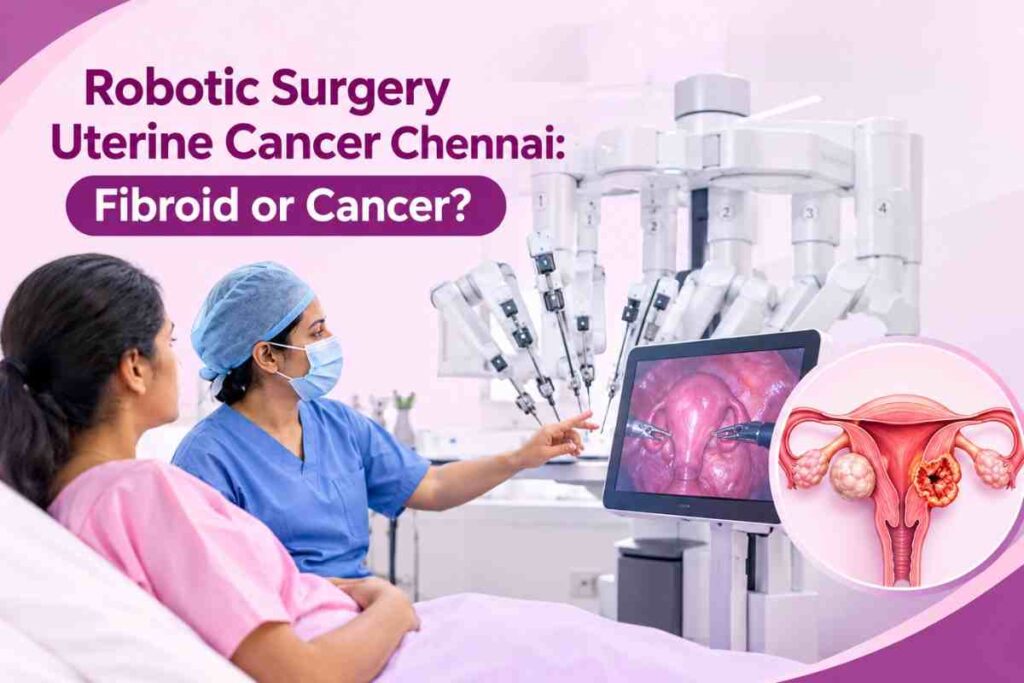
Robotic Surgery Uterine Cancer Chennai: Fibroid or Cancer? She noticed the bleeding had changed. Heavier some months, lighter the next, then suddenly present between periods when it had no business being there. A scan at a local clinic in Chennai flagged “a growth in the uterus” and nothing more. Was it a fibroid, something she’d likely live with for years? Or something that needed urgent attention? This uncertainty is exactly why robotic surgery uterine cancer Chennai searches have grown among women trying to understand their own scan reports before they even sit down with a specialist. Fibroid vs Cancer Diagnosis: Understanding the Difference A uterine fibroid is a non-cancerous growth made of muscle and fibrous tissue that develops within or around the uterine wall. Most fibroids are harmless, though they can cause heavy bleeding, pelvic pressure, or discomfort during daily activities. Endometrial cancer, by contrast, begins in the lining of the uterus, the endometrium, and behaves very differently from a fibroid. It requires a distinct diagnostic pathway and a different kind of surgical expertise altogether. The trouble is that both conditions can present with strikingly similar symptoms on the surface. Irregular bleeding, pelvic heaviness, and a growth visible on ultrasound can point to either possibility. A scan alone rarely settles the question. What actually distinguishes fibroid from cancer is a combination of imaging pattern, bleeding history, and, in many cases, an endometrial biopsy read by someone trained specifically in gynecologic oncology. Ultrasound reports can describe a mass as “heterogeneous” or “irregular” without ever telling a patient what that actually means for her. A fibroid tends to have a defined border and a consistent texture, while a malignant growth often shows irregular margins, unusual blood flow patterns, or thickening of the endometrial lining beyond what’s expected for a patient’s age and menstrual stage. Recognising these distinctions is part of why imaging should always be read alongside a clinical history, not in isolation. Why This Matters for Women in Chennai and Tamil Nadu Across Chennai and the wider Tamil Nadu region, women often delay a gynecology visit until symptoms become disruptive, partly out of a cultural tendency to normalise bleeding irregularities as “just hormones” or “just age.” That delay is understandable. It is also the exact gap that a fellowship-trained gynecologic oncologist is meant to close. If you’ve been asking yourself how to know if uterine growth is cancerous, Chennai doctor visits should not stop at a general ultrasound reading. The city now has access to sub-specialist gynecologic oncology care that many patients previously had to travel to Mumbai or Delhi to receive. That local access changes outcomes. A growth that might otherwise sit unexamined for months can now be properly evaluated within the same city, by someone trained to distinguish a benign fibroid from an early cancer with confidence. Dr. Aiswarya Sekar’s Approach and Expertise Dr. Aiswarya Sekar brings a background that few gynecologic surgeons in Chennai can match. Her MCh in Gynecologic Oncology was completed at Tata Memorial Hospital in Mumbai, widely regarded as India’s leading cancer centre, where she trained specifically in distinguishing complex uterine and ovarian pathology and managing it surgically. That training underpins how she evaluates every patient who walks in with an ambiguous scan report. At Dr. Rela Institute and Medical Centre in Chromepet, Dr. Aiswarya practises as a robotic gynecologic surgeon Chennai patients increasingly seek out specifically because robotic technique allows for smaller incisions, more precise tissue handling, and a faster return to normal life compared with open surgery. For suspected uterine cancer, this precision matters even more, since accurate staging during surgery directly shapes what treatment follows. Where the situation allows, she also prioritises fertility-preserving approaches for younger patients facing early-stage disease, a nuance that generic hospital blogs rarely address with real clinical depth. Not every diagnosis of uterine growth means losing the option of future pregnancy, and that possibility deserves to be discussed honestly rather than assumed away. For anyone searching robotic surgery for suspected uterine cancer near me, the decision of who performs that surgery matters as much as the decision to have it. A gynecologic oncologist trained to operate with cancer-specific staging in mind approaches the procedure differently than a general gynecologist would, even when using the same robotic platform. What to Expect: Your Care Journey at Rela Hospital The first visit typically begins with a detailed review of your bleeding pattern, medical history, and any prior scans you bring along. Dr. Aiswarya will often recommend a transvaginal ultrasound if one hasn’t already been done properly, followed by an endometrial biopsy when the growth pattern or bleeding history raises any concern. If you’re searching for the best gynec oncologist for endometrial biopsy Chennai has to offer, this step is worth understanding clearly. An endometrial biopsy is a brief outpatient procedure where a small tissue sample is taken from the uterine lining for pathology review. It sounds daunting on paper, but most patients describe it as uncomfortable rather than painful, and results usually guide the next steps within a short window. Should the biopsy confirm fibroid tissue, treatment options range from monitoring to minimally invasive removal, depending on symptoms and your goals. Should it point toward malignancy, Dr. Aiswarya and her team move into staging discussions, imaging review, and a surgical plan tailored to your specific case, explained in plain terms before any decision is made. Follow-up care at Rela continues well beyond surgery, with a structured review schedule designed to catch anything early. Throughout this process, questions are welcomed rather than rushed past. Patients are encouraged to bring a family member or friend to consultations, to write down their questions beforehand, and to ask for clarification whenever medical terminology feels unclear. A diagnosis, whichever direction it points, lands easier when the person delivering it takes the time to make sure you actually understand it, not just hear it. Warning Signs: When You Should See a Specialist Certain symptoms warrant
Fertility Preserving Ovarian Cancer Treatment in Chennai
Advanced Ovarian Cancer Treatment Specialist in Chennai She was still in her twenties, unmarried, with no children yet, when the ultrasound found something on her ovary that needed a biopsy. Her first question to the doctor wasn’t about survival. It was about whether this meant she’d never be able to have children of her own. That question — quieter than fear, but just as heavy — is exactly what fertility preserving ovarian cancer treatment Chennai specialists are trained to help answer honestly, without dismissing it as secondary to the diagnosis itself. Understanding Ovarian Cancer Surgery in Young Women Ovarian cancer in younger women often behaves differently than it does in older patients. It’s more likely to be caught at an earlier stage, and the tumour types seen in younger patients frequently respond well to treatment that removes the affected ovary while leaving the healthy one, along with the uterus, intact. This is the foundation of fertility-sparing surgery. Rather than defaulting to a full hysterectomy with removal of both ovaries — the traditional approach for ovarian cancer — a fertility sparing oncology surgeon carefully evaluates whether the cancer is confined enough, and the tumour type favourable enough, to preserve reproductive organs safely. It isn’t the right option for every patient or every stage of disease, but where it applies, it changes what a diagnosis means for a woman’s future entirely. Why This Matters for Women in Chennai and Tamil Nadu Many young women across Tamil Nadu facing an ovarian cancer diagnosis are told, sometimes by well-meaning family or even by doctors without oncology-specific training, that removing everything is simply the safer choice. That advice isn’t always wrong, but it isn’t always necessary either, and the difference matters enormously to a woman who hasn’t yet started or completed her family. Can young women preserve fertility after ovarian cancer surgery is one of the most searched questions among patients in this age group, and the honest answer is: often, yes, when the diagnosis is caught early and the surgery is performed by someone with the specific expertise to assess it properly. Having that expertise available within Chennai means women don’t have to choose between getting a second opinion and starting treatment quickly. Dr. Aiswarya Sekar’s Approach and Expertise Dr. Aiswarya Sekar practices as a Consultant Gynecologic Oncologist and Robotic Surgeon at Dr. Rela Institute and Medical Centre in Chromepet, Chennai, with training from Tata Memorial Hospital in Mumbai, one of India’s premier cancer centres, along with her academic foundation from Madras Medical College and Thanjavur Medical College. For women researching the best doctor for fertility sparing ovarian surgery Chennai has to offer, her practice is built specifically around this kind of nuanced decision-making. She evaluates the tumour type, stage, and spread carefully before recommending a surgical plan, and where egg preservation before cancer surgery is medically relevant — particularly if chemotherapy is also needed — she coordinates that conversation early, before treatment timelines make it more difficult. Her robotic surgical technique also supports this approach, allowing for precise removal of affected tissue with minimal disruption to surrounding reproductive structures. What to Expect: Your Care Journey at Rela Hospital For a younger woman, this diagnosis often collides with life plans she hasn’t finished making yet, and that collision deserves care that acknowledges it directly. Your first consultation will include a detailed review of your imaging and pathology, along with an honest conversation about whether fertility preservation is realistically possible in your specific case. If it is, Dr. Aiswarya Sekar will walk you through ovarian cancer treatment options for women wanting children, including what surgery would involve, whether fertility preservation steps like egg or embryo freezing make sense before treatment begins, and what monitoring will look like afterward. If preservation isn’t advisable due to the extent of disease, she’ll explain why clearly, so the decision never feels arbitrary. Follow-up after fertility-sparing surgery continues closely, since the goal isn’t just treating the cancer but protecting your long-term reproductive health alongside it. Warning Signs: When You Should See a Specialist The following symptoms warrant a prompt evaluation by a gynecologic oncologist, especially in younger women: Persistent bloating or abdominal swelling that doesn’t resolve Pelvic pain that continues beyond a few weeks A noticeable lump or mass found on pelvic examination or scan Irregular periods alongside unexplained pelvic discomfort Feeling full quickly or unexplained changes in appetite A family history of ovarian or breast cancer, particularly with a known BRCA1 or BRCA2 mutation Always consult a qualified medical professional for diagnosis and treatment. Self-diagnosis based on online information is never a substitute for a clinical evaluation. Moving Forward, With the Right Support Facing an ovarian cancer diagnosis young, while still holding onto plans for a family, asks for a particular kind of resilience. Wanting both survival and the chance to become a mother later isn’t asking for too much — it’s a reasonable thing to fight for. Dr. Aiswarya Sekar and her team at Dr. Rela Institute and Medical Centre, Chromepet, Chennai, are ready to explore every fertility-preserving option available to you. Book a consultation or visit the OPD to start that conversation on your own terms. Medically reviewed by Dr. Aiswarya Sekar, Gynecologic Oncologist and Robotic Surgeon, Dr. Rela Institute and Medical Centre, Chennai Rencent Blogs. Advanced Ovarian Cancer Treatment Specialist in Chennai Lynch Syndrome Uterine Cancer Consultation in Chennai Explained Endometrial Cancer Symptoms: When to See a Doctor in Chennai Robotic Surgery for Gynecologic Cancer Cost in Chennai Ovarian Cyst Specialist Consultation Chennai Vulvar Cancer Treatment Specialist Chennai Cervical Cancer Surgery Chennai: Robotic vs Open Best Gynecologic Oncologist in Chennai for Second Opinion BRCA Gene Test Consultation Chennai: What to Know If Ovarian Cancer Runs in Your Family Robotic Hysterectomy for Endometrial Cancer Chennai For Nurses Who Apply, We Offer Careers. Contact Us
Advanced Ovarian Cancer Treatment Specialist in Chennai
Advanced Ovarian Cancer Treatment Specialist in Chennai The scan report used words she didn’t fully understand, but the tone of the call that followed told her enough. Advanced. Spread beyond the ovary. Needs a specialist. In the hours after, she sat with her family trying to figure out what came next, and what came next was a search for an advanced ovarian cancer treatment specialist Chennai could offer close to home, rather than a scramble to travel somewhere unfamiliar during the hardest weeks of her life. If you’re in that same place right now, know this — advanced does not mean untreatable, and where you go for care matters enormously. Understanding Advanced-Stage Ovarian Cancer Surgery Options Ovarian cancer is often described as a silent disease because early symptoms — bloating, pelvic discomfort, changes in appetite — are easy to mistake for something far less serious. By the time many women are diagnosed, the cancer has already spread beyond the ovary itself, which is what doctors mean by an advanced or later stage of disease. This diagnosis understandably feels overwhelming, but advanced-stage ovarian cancer surgery options have improved considerably. The central procedure at this stage is cytoreductive surgery ovarian cancer specialists use to remove as much visible tumour as possible, often combined with chemotherapy given either before or after the operation. In select cases, a heated chemotherapy treatment delivered directly into the abdominal cavity during surgery, known as HIPEC, is used to target microscopic disease that surgery alone cannot reach. None of this is simple, but it is a well-established path with real outcomes behind it. Why This Matters for Women in Chennai and Tamil Nadu Advanced ovarian cancer surgery is technically demanding, and not every hospital or surgeon in Tamil Nadu has the specific training to perform extensive cytoreductive procedures safely. This is precisely where where to treat stage III ovarian cancer South India becomes a genuinely important question rather than a formality — the surgeon’s experience with this exact type of operation directly influences how much disease can be safely removed, which in turn shapes everything that follows. For years, many families in Chennai and across Tamil Nadu assumed that this level of surgical expertise meant travelling to Mumbai, Delhi, or beyond. That assumption is increasingly outdated. Having a fellowship-trained gynecologic oncosurgeon with dedicated cancer-centre training available within the city changes what’s possible for local patients, without adding travel and unfamiliar surroundings to an already difficult diagnosis. Dr. Aiswarya Sekar’s Approach and Expertise Dr. Aiswarya Sekar is a Consultant Gynecologic Oncologist and Robotic Surgeon at Dr. Rela Institute and Medical Centre in Chromepet, Chennai, trained at Tata Memorial Hospital in Mumbai, one of the country’s leading cancer centres, with her academic foundation from Madras Medical College and Thanjavur Medical College. For patients researching the best doctor for advanced ovarian cancer treatment in Chennai, her practice specifically includes cytoreductive surgery and HIPEC for advanced ovarian cancer, alongside sentinel lymph node biopsy and broader oncologic surgical expertise. She approaches each case individually, assessing how extensive the disease is, what surgery can realistically achieve, and how that fits alongside chemotherapy and other treatments. Her training equips her to pursue thorough cytoreduction while remaining honest with patients about what the surgery can and cannot accomplish — a balance that matters enormously when trust is already fragile. What to Expect: Your Care Journey at Rela Hospital An advanced cancer diagnosis often arrives with more questions than answers, and simply understanding the sequence of what happens next can bring real relief. Your journey usually begins with a thorough review of your imaging and prior reports, followed by further staging tests to understand exactly how far the disease has spread. From there, Dr. Sekar and her multidisciplinary team, including medical oncology, will discuss whether cytoreductive surgery cost and recovery Chennai patients ask about fits your specific case, and whether it should happen before or after a course of chemotherapy. Recovery from major cytoreductive surgery takes real time and support, and the team at Rela Institute works to prepare you and your family for that period, not just the operation itself. You are not expected to absorb every detail in one sitting. Questions can, and should, continue across every visit. Warning Signs: When You Should See a Specialist The following symptoms warrant a prompt evaluation by a gynecologic oncologist, particularly if they are new, persistent, or worsening: Ongoing bloating or abdominal swelling that doesn’t resolve Pelvic or abdominal pain that persists beyond a few weeks Feeling full quickly or difficulty eating as usual Unexplained changes in bowel or bladder habits Unintended weight loss alongside digestive discomfort A family history of ovarian, breast, or related cancers, particularly with a known BRCA1 or BRCA2 mutation Always consult a qualified medical professional for diagnosis and treatment. Self-diagnosis based on online information is never a substitute for a clinical evaluation. Moving Forward, With the Right Support An advanced diagnosis can feel like the ground shifting beneath you, but choosing the right surgical team is one of the most meaningful decisions you can make in that moment, and simply seeking a second opinion is never a wasted step. Dr. Aiswarya Sekar and her team at Dr. Rela Institute and Medical Centre, Chromepet, Chennai, are equipped to guide you through advanced ovarian cancer treatment with honesty and genuine expertise. Book a consultation, request a second opinion, or visit the OPD — whichever feels right as your next step. Medically reviewed by Dr. Aiswarya Sekar, Gynecologic Oncologist and Robotic Surgeon, Dr. Rela Institute and Medical Centre, Chennai Rencent Blogs. Advanced Ovarian Cancer Treatment Specialist in Chennai Lynch Syndrome Uterine Cancer Consultation in Chennai Explained Endometrial Cancer Symptoms: When to See a Doctor in Chennai Robotic Surgery for Gynecologic Cancer Cost in Chennai Ovarian Cyst Specialist Consultation Chennai Vulvar Cancer Treatment Specialist Chennai Cervical Cancer Surgery Chennai: Robotic vs Open Best Gynecologic Oncologist in Chennai for Second Opinion BRCA Gene Test Consultation Chennai: What to Know If
Lynch Syndrome Uterine Cancer Consultation in Chennai Explained
Lynch Syndrome Uterine Cancer Consultation in Chennai Explained Her mother had it. Her aunt had it too, on the other side of the family, years apart, as though the timing was almost coincidental. It wasn’t until a cousin mentioned the word “Lynch syndrome” after her own diagnosis that the pattern suddenly looked less like bad luck and more like something worth asking a doctor about. That’s often how it begins — not with a symptom, but with a memory of one relative too many, and a question that finally gets asked out loud. If that sounds familiar, a Lynch syndrome uterine cancer consultation Chennai can give you real answers instead of years of quiet worry. Understanding Hereditary Uterine Cancer Screening Lynch syndrome is an inherited genetic condition that significantly raises the lifetime risk of several cancers, most notably colorectal and uterine cancer. It happens because of a mutation in one of the genes responsible for repairing errors in DNA — when that repair mechanism doesn’t work properly, cells are more likely to develop the changes that lead to cancer over time. For many women, uterine cancer is actually the first cancer linked to Lynch syndrome to appear, sometimes even before any bowel-related symptoms show up. This is exactly why hereditary uterine cancer screening matters so much for women with a strong family history. It isn’t about assuming the worst. It’s about understanding whether your family’s pattern is genetic, and if so, what that means for monitoring your health proactively rather than reactively. Why This Matters for Women in Chennai and Tamil Nadu Genetic counselling is still a relatively new concept for many families in Tamil Nadu, and hereditary cancer risk often goes unspoken about, even when the pattern across generations is fairly clear. A grandmother’s cancer, a mother’s cancer, an aunt’s cancer — these get remembered as separate events rather than connected pieces of a single genetic picture. If you’ve been wondering should I be tested for Lynch syndrome before hysterectomy, particularly because of a family history of uterine or colorectal cancer, that question deserves a proper answer before, not after, a major surgical decision. Testing beforehand can actually shape the surgical approach itself, including whether additional preventive procedures make sense at the same time. Access to this kind of genetic counselling gynecologic oncology service is still limited across the region, which makes a proper hereditary cancer risk assessment gynecologic oncologist consultation genuinely valuable for families in and around Chennai. Dr. Aiswarya Sekar’s Approach and Expertise Dr. Aiswarya Sekar practices as a Consultant Gynecologic Oncologist and Robotic Surgeon at Dr. Rela Institute and Medical Centre in Chromepet, Chennai, trained at Tata Memorial Hospital in Mumbai, alongside her academic foundation at Madras Medical College and Thanjavur Medical College. Her practice specifically includes hereditary cancer syndromes, including Lynch syndrome and BRCA-related risk, which means a family history of uterine cancer doctor consultation Chennai search doesn’t have to lead you to a general gynecologist unfamiliar with genetic risk pathways. She approaches these consultations by looking at the full family picture, not a single relative’s diagnosis in isolation, and guides patients through what genetic testing actually involves, what a positive or negative result would mean, and how it might influence future screening or surgical decisions. Where fertility remains a consideration, she factors that into her recommendations as well, rather than defaulting to the most aggressive option available. What to Expect: Your Care Journey at Rela Hospital Walking into a genetic risk conversation can feel more uncertain than a standard medical visit, mostly because the questions involved go beyond your own body to your entire family history. Your first consultation typically starts with a detailed family history review, mapping out which relatives had which cancers and at what age they were diagnosed, since these patterns are central to identifying hereditary cancer risk assessment gynecologic oncologist recommendations. If genetic testing is appropriate, Dr. Sekar will explain the process clearly, including what the test can and cannot tell you. Based on the results, she’ll discuss a personalised plan, which might include more frequent screening, additional preventive steps, or simply a clearer understanding that puts your mind at ease. This isn’t a one-time conversation. It’s the start of an ongoing relationship where your risk profile is actively managed rather than left to chance. Warning Signs: When You Should See a Specialist The following situations warrant a consultation with a gynecologic oncologist for hereditary cancer risk assessment: A close family member diagnosed with uterine, ovarian, or colorectal cancer, particularly at a younger age Multiple relatives across generations with uterine or colorectal cancer A known Lynch syndrome or BRCA1/BRCA2 mutation elsewhere in the family Personal history of colorectal polyps or cancer alongside a family history of uterine cancer Abnormal uterine bleeding in someone with a significant family cancer history Planning a hysterectomy or other gynecologic surgery with an unclear or concerning family history Always consult a qualified medical professional for diagnosis and treatment. Self-diagnosis based on online information is never a substitute for a clinical evaluation. Moving Forward, With the Right Support Asking about your family’s cancer history takes a certain kind of honesty, especially when it means confronting a pattern you’ve noticed but never quite said aloud. That honesty is where informed, proactive care begins. Dr. Aiswarya Sekar and her team at Dr. Rela Institute and Medical Centre, Chromepet, Chennai, are ready to walk through your family history with you and help you understand what it actually means for your health. Book a consultation or visit the OPD when you’re ready to turn that question into clarity. Medically reviewed by Dr. Aiswarya Sekar, Gynecologic Oncologist and Robotic Surgeon, Dr. Rela Institute and Medical Centre, Chennai Rencent Blogs. Advanced Ovarian Cancer Treatment Specialist in Chennai Lynch Syndrome Uterine Cancer Consultation in Chennai Explained Endometrial Cancer Symptoms: When to See a Doctor in Chennai Robotic Surgery for Gynecologic Cancer Cost in Chennai Ovarian Cyst Specialist Consultation Chennai Vulvar
Endometrial Cancer Symptoms: When to See a Doctor in Chennai
Endometrial Cancer Symptoms: When to See a Doctor in Chennai It started as something she almost didn’t mention to anyone — a little spotting, weeks after she thought her periods were long behind her. She told herself it was probably nothing, maybe stress, maybe her age catching up with her. But it happened again. And that second time, she finally searched for an endometrial cancer doctor consultation Chennai, because some quiet part of her knew this wasn’t a symptom to wait out. If you’re reading this for a similar reason, that instinct to look closer is worth trusting. Understanding Uterine Cancer Diagnosis: What Abnormal Bleeding Cancer Evaluation Really Means Endometrial cancer begins in the lining of the uterus, the endometrium, and it’s the most common gynecologic cancer diagnosed in women after menopause. The reassuring part of an otherwise frightening topic is this: it’s also one of the most treatable gynecologic cancers, largely because it tends to announce itself early through bleeding that doesn’t fit the pattern it should. That’s what an abnormal bleeding cancer evaluation is really about. Bleeding after menopause, bleeding between periods, or periods that have become heavier or more irregular than usual are not something to explain away. They don’t automatically mean cancer — fibroids, hormonal shifts, and polyps cause similar symptoms far more often. But the only way to know which one you’re dealing with is a proper uterine cancer diagnosis workup, not a guess based on what feels most likely. Why This Matters for Women in Chennai and Tamil Nadu There’s a quiet tendency among many women in Tamil Nadu to treat postmenopausal bleeding as an inconvenience rather than a signal. It gets attributed to age, to stress, to “just the body changing,” and a visit to the doctor gets pushed back by weeks or months. That delay is often the single biggest factor separating an early, highly treatable diagnosis from a more complicated one. If you’re asking postmenopausal bleeding which doctor to consult Chennai, the honest answer is: not just any gynecologist, but one equipped to properly evaluate and, if needed, manage a gynecologic cancer diagnosis without another referral delay. Chennai now has that expertise within the city, which means women across Tamil Nadu no longer need to treat a straightforward first evaluation as a reason to travel elsewhere. Dr. Aiswarya Sekar’s Approach and Expertise Dr. Aiswarya Sekar is a Consultant Gynecologic Oncologist and Robotic Surgeon at Dr. Rela Institute and Medical Centre in Chromepet, Chennai, with training from Tata Memorial Hospital in Mumbai — one of the country’s most respected cancer centres — alongside her academic background from Madras Medical College and Thanjavur Medical College. Her practice is built around exactly this kind of gynecologic oncology appointment Chennai patients need when a symptom like abnormal bleeding raises questions. She doesn’t rush toward the most severe explanation, nor does she dismiss a symptom that deserves a closer look. Her evaluations are thorough, and when uterine cancer is confirmed, her expertise in robotic and minimally invasive surgical techniques often allows for less invasive treatment with a faster recovery than traditional open surgery. In select early-stage cases, she also considers fertility-preserving approaches, understanding that a diagnosis at a younger age can carry concerns beyond treatment alone. What to Expect: Your Care Journey at Rela Hospital Not knowing what a visit will involve is often what keeps women from booking it in the first place. It helps to know the actual shape of that path. Your first visit typically involves a detailed conversation about your symptoms, medical history, and any relevant family history, followed by a pelvic examination. Depending on what’s found, further evaluation may include an ultrasound or a biopsy of the endometrial tissue to determine exactly what’s causing the bleeding. If a diagnosis of uterine or endometrial cancer is confirmed, Dr. Sekar will walk you through your treatment options clearly, including whether robotic surgery is appropriate for your case. When people search for the best doctor for endometrial cancer diagnosis Chennai has to offer, what they’re often really looking for is this: a specialist who won’t leave them guessing at any stage, in a hospital with the infrastructure to move from diagnosis to treatment without unnecessary delay. That coordinated approach is central to how care is delivered at Rela Institute. Warning Signs: When You Should See a Specialist The following symptoms warrant a visit to a gynecologic oncologist rather than a wait-and-see approach: Any vaginal bleeding after menopause, however light Bleeding between periods or periods that have become unusually heavy or prolonged Watery or blood-tinged vaginal discharge without an obvious cause Pelvic pain or a feeling of pressure that persists Unintended changes in weight alongside abnormal bleeding A personal or family history of uterine, ovarian, or colon cancer, or known Lynch syndrome Always consult a qualified medical professional for diagnosis and treatment. Self-diagnosis based on online information is never a substitute for a clinical evaluation. Moving Forward, With the Right Support Noticing a symptom and choosing to act on it is not overreacting. It’s the most sensible thing you can do for yourself, even when part of you hopes the answer will be nothing. Dr. Aiswarya Sekar and her team at Dr. Rela Institute and Medical Centre, Chromepet, Chennai, are here to walk through that evaluation with you, honestly and without unnecessary alarm. Book a consultation or visit the OPD when you’re ready — you don’t need certainty before you take that first step, only the willingness to ask. Medically reviewed by Dr. Aiswarya Sekar, Gynecologic Oncologist and Robotic Surgeon, Dr. Rela Institute and Medical Centre, Chennai Rencent Blogs. Advanced Ovarian Cancer Treatment Specialist in Chennai Lynch Syndrome Uterine Cancer Consultation in Chennai Explained Endometrial Cancer Symptoms: When to See a Doctor in Chennai Robotic Surgery for Gynecologic Cancer Cost in Chennai Ovarian Cyst Specialist Consultation Chennai Vulvar Cancer Treatment Specialist Chennai Cervical Cancer Surgery Chennai: Robotic vs Open Best Gynecologic Oncologist in Chennai
Robotic Surgery for Gynecologic Cancer Cost in Chennai
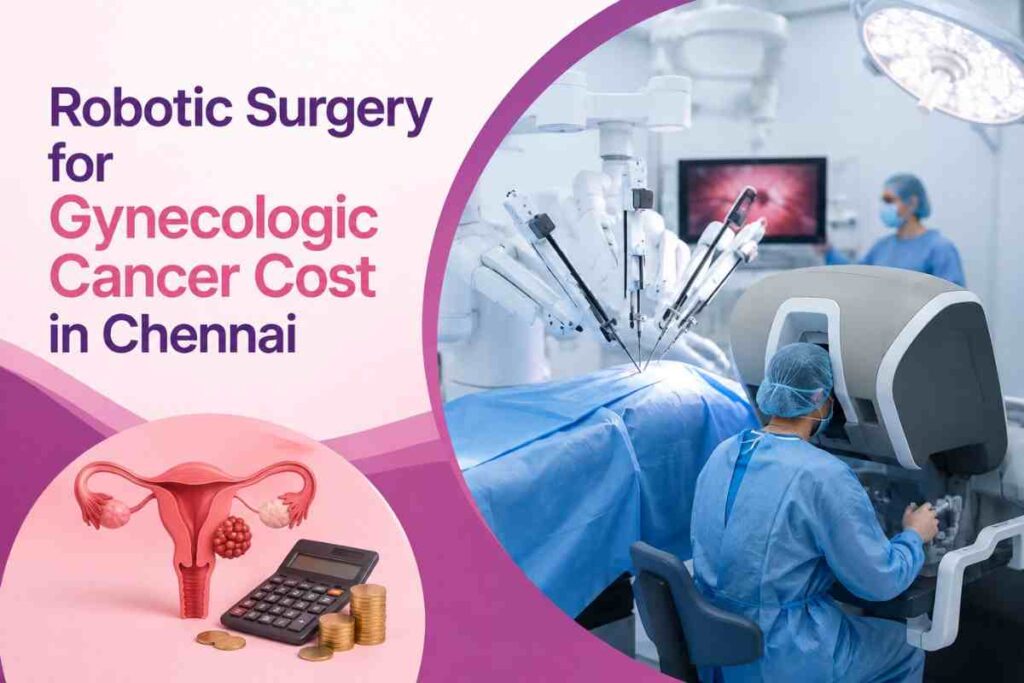
Robotic Surgery for Gynecologic Cancer Cost in Chennai She noticed it during a routine check-up — a finding her gynaecologist wanted a specialist to look at more closely. In the days that followed, she did what most of us do. She searched. She read. She tried to understand what came next, and somewhere in that search, a new question surfaced: what does robotic surgery for gynecologic cancer cost in Chennai, and is it even the right choice for someone like her. If you’re asking that same question right now, you’re not alone, and you’re not overreacting. You’re doing exactly what a woman should do when something doesn’t feel right — you’re looking for answers before you look for a doctor. Understanding Minimally Invasive Gynecologic Oncology Surgery Gynecologic cancers — of the ovary, uterus, cervix, or vulva — are treated differently depending on where they’re found and how far they’ve progressed. Traditionally, surgery for these cancers meant a large abdominal incision, a longer hospital stay, and a slow, painful recovery. Minimally invasive gynecologic oncology surgery changes that picture entirely. Robotic surgery uses a console-guided system that gives the surgeon a magnified, three-dimensional view of the pelvis along with instruments that move with a precision the human hand alone cannot replicate. Small incisions replace one large one. Blood loss drops. Recovery shortens. For cancers that require careful, thorough removal of tissue and lymph nodes, that precision isn’t a luxury — it’s often what allows a surgeon to be both aggressive against the disease and gentle with the body carrying it. Why This Matters for Women in Chennai and Tamil Nadu Chennai has quietly become a serious destination for advanced cancer care, but access to a fellowship-trained gynecologic oncosurgeon — someone who has actually trained in high-volume cancer centres and operates robotically as a routine part of practice — remains limited across Tamil Nadu. Many women from smaller towns still travel out of the state, sometimes out of the country, simply because they don’t know that this level of expertise now exists closer to home. This is exactly the gap that shapes how much does robotic cancer surgery cost in Chennai as a search question. Patients aren’t just comparing numbers on a bill. They’re comparing what they’d have to give up — time away from family, travel, unfamiliar hospitals — against what they’d gain by staying local. When a city like Chennai offers internationally trained oncologic surgical expertise, that calculation changes. Care becomes something you don’t have to leave home to receive. Dr. Aiswarya Sekar’s Approach and Expertise Dr. Aiswarya Sekar brings a background that few gynecologic oncosurgeons in the region can match. Her training includes time at Tata Memorial Hospital in Mumbai — widely regarded as India’s leading cancer centre — alongside her academic grounding from Madras Medical College and Thanjavur Medical College. She now practices as a Consultant Gynecologic Oncologist and Robotic Surgeon at Dr. Rela Institute and Medical Centre in Chromepet, Chennai. Is robotic surgery better than open surgery for cancer? It depends entirely on the individual case, and Dr. Sekar’s approach reflects that nuance rather than a one-size-fits-all answer. Her practice spans ovarian, uterine, cervical, and vulvar cancers, along with procedures like HIPEC and cytoreductive surgery for advanced disease. What sets her apart is not only the robotic technique itself, but the philosophy behind it — wherever medically appropriate, she prioritises fertility-preserving oncologic surgery, recognising that a cancer diagnosis doesn’t have to mean the end of a woman’s reproductive future. This is oncology practiced with both precision and empathy, not procedure for its own sake. What to Expect: Your Care Journey at Rela Hospital Anxiety about the unknown is often heavier than the diagnosis itself. Knowing what the path looks like can ease that weight considerably. Your journey typically begins with a detailed consultation, where Dr. Sekar reviews your history, imaging, and any prior reports to understand the full picture. From there, further diagnostic tests — imaging, biopsy, or blood work — help confirm the type and stage of the condition. If robotic surgery is recommended, you’ll receive a clear explanation of the procedure, what to expect during recovery, and how it compares with alternative approaches, so you’re making an informed decision rather than a rushed one. Among the robotic surgery hospitals for gynecologic cancer Chennai has to offer, Rela Institute stands out for combining advanced surgical infrastructure with a multidisciplinary oncology team — medical oncologists, radiation specialists, and supportive care staff working alongside your surgeon. After the procedure, recovery is typically faster than with open surgery, with less post-operative pain and a quicker return to daily activities, though your care team will guide you through a follow-up schedule tailored specifically to your case. Warning Signs: When You Should See a Specialist Certain symptoms warrant a prompt visit to a gynecologic oncologist rather than a wait-and-watch approach: Unusual vaginal bleeding, especially after menopause Persistent pelvic or abdominal pain that doesn’t resolve Ongoing bloating or a feeling of fullness without a clear cause Unexplained changes in bowel or bladder habits Any lump, sore, or unusual change in the vulvar area A family history of ovarian, breast, or related cancers, particularly with known BRCA1 or BRCA2 mutations Always consult a qualified medical professional for diagnosis and treatment. Self-diagnosis based on online information is never a substitute for a clinical evaluation. Moving Forward, With the Right Support Seeking out a specialist takes a particular kind of courage — the courage to face uncertainty head-on instead of hoping it resolves on its own. If you’ve read this far, you’ve likely already found that courage. Dr. Aiswarya Sekar and her team at Dr. Rela Institute and Medical Centre, Chromepet, Chennai, are available to guide you through every step, from your first consultation to long-term follow-up care. You don’t have to navigate this alone, and you don’t have to have every question answered before you reach out. Book a consultation or visit the OPD to begin